
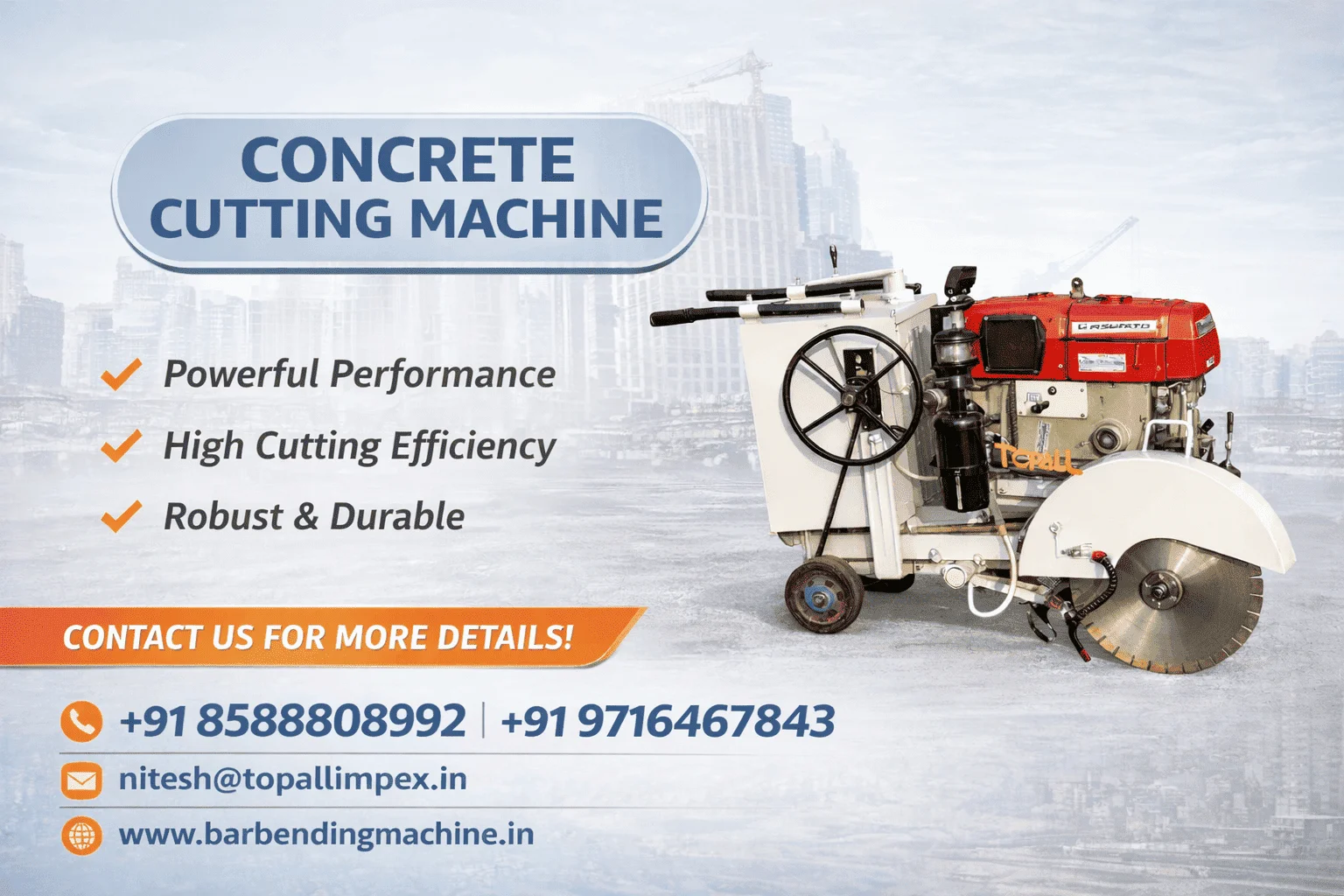
Delhi's Most Trusted Concrete Cutting Machine Manufacturer and Supplier Since 2008 — Topall Impex
A concrete cutting machine is a powerful, precision-engineered tool designed to cut through concrete, asphalt, masonry, and reinforced structures with speed and accuracy. Used across construction, road repair, plumbing, demolition, and renovation projects, these machines deliver clean cuts while minimizing structural damage and labor effort. At Topall Impex, we manufacture and supply high-performance concrete cutting machines in Delhi since 2008. Our range includes floor saws, wall saws, core drilling machines, handheld cut-off saws, and multi-cutter systems — built for India's toughest job sites. Whether you need to cut a road slab, open a wall, or drill a clean core hole, we have the right machine for your project. We offer factory-direct pricing, genuine spare parts, and full after-sales support.
Contact Topall Impex today and get the best concrete cutting machine at the most competitive price in Delhi.
When precision matters on a construction site, the tools you choose define the quality of your work. At Topall Impex, we are the top Manufacturer of Groove Cutting Machine - CQF16 Concrete Groove Cutting Machine, CQF28 Concrete Groove Cutting Machine, CQF40 Concrete Groove Cutting Machine and CFQ16 Semi Automatic Concrete Groove Cutting Machine offered by Topall Impex, New Delhi, Delhi.. Whether you are cutting slabs, roads, walls, or pipes, we deliver machines that work as hard as you do — every single day.
What Is a Concrete Cutting Machine?
A concrete cutting machine is a heavy-duty power tool designed to cut through concrete, asphalt, masonry, stone, and reinforced structures with precision and control. It uses diamond-tipped blades, abrasive discs, or wire saws to make clean, accurate cuts in surfaces that ordinary tools simply cannot handle.
These machines are engineered to perform in demanding environments — from urban road repair to high-rise construction — where clean cuts, minimal vibration, and structural accuracy are non-negotiable.
Unlike manual chiseling or conventional drilling, a concrete cutting machine delivers:
- Straight, controlled cuts without structural damage
- Faster completion of tasks
- Reduced labor cost and physical effort
- Consistent depth and width with every pass
In simple terms, if your project involves concrete, a concrete cutter is not optional — it is essential.
Where Are Concrete Cutting Machines Used?
Concrete cutting machines serve a wide range of industries and project types. Here is where you will find them in active use:
Construction and Civil Engineering — Cutting slabs, beams, columns, and foundations during new construction or structural modification.
Road and Highway Work — Cutting asphalt and concrete roads for repair, expansion joints, utility trenching, and resurfacing.
Plumbing and Electrical Work — Creating wall and floor channels to install pipes, conduits, cables, and drainage systems.
Demolition Projects — Controlled demolition of specific sections without disturbing surrounding structures.
Renovation and Retrofitting — Opening walls or floors to add doors, windows, ventilation shafts, or new structural elements.
Waterproofing and Flooring — Cutting control joints in concrete floors to prevent random cracking and prepare surfaces for waterproofing treatments.
Bridge and Flyover Maintenance — Precision cutting of bridge decks and support beams during repair and inspection work.
Industrial Facilities — Cutting factory floors, drainage channels, and structural walls in manufacturing and processing plants.
Wherever concrete exists, a concrete cutting machine plays a critical role in shaping, repairing, or removing it.
Benefits of Using a Concrete Cutting Machine
Every professional who has switched from manual methods to machine cutting knows the difference immediately. Here are the core benefits:
Speed and Efficiency — Machines cut through thick concrete in a fraction of the time manual methods require. This directly saves you labor hours and project costs.
Clean and Precise Cuts — Diamond blades produce smooth, straight edges with minimal chipping. This is especially important for aesthetic finishes and structural integrity.
Reduced Structural Damage — Machine cutting limits vibration and stress on surrounding concrete, protecting the structure from micro-cracks or unintended fractures.
Operator Safety — Modern concrete cutting machines come with safety guards, ergonomic handles, and dust suppression systems that protect workers on-site.
Versatility — One machine can cut concrete, stone, brick, asphalt, and tile depending on the blade used.
Cost Savings Over Time — A well-maintained machine reduces your dependence on expensive rental services and repeated outsourcing.
Dust Control — Wet cutting systems and vacuum attachments minimize harmful silica dust exposure, keeping your worksite compliant with health and safety regulations.
Why Is a Concrete Cutting Machine Important in Construction?
Construction projects today demand precision that manual tools cannot deliver. Here is why a concrete cutting machine has become a standard requirement on every modern job site:
Modern infrastructure — roads, bridges, high-rises, metro lines — involves reinforced concrete structures. Cutting these accurately requires specialized power and blade technology. A slight error in depth or alignment can compromise structural performance and delay the entire project.
Beyond accuracy, time is money in construction. A concrete cutting machine completes in minutes what would otherwise take hours of manual labor. For large-scale projects, this translates directly into cost savings and faster delivery timelines.
Additionally, regulatory and safety standards now require controlled, precise cuts — especially in urban environments where vibration, dust, and noise must be minimized. Concrete cutting machines address all of these requirements simultaneously.
In short, a concrete cutting machine is not just a productivity tool. It is a quality assurance tool for the modern construction professional.
How Does a Concrete Cutting Machine Work?
Understanding how a concrete cutting machine works helps you choose the right type for your project and operate it correctly.
The machine works by rotating a diamond-segmented or abrasive blade at high speed. As the blade contacts the concrete surface, the diamond or abrasive particles grind through the material rather than cutting it like a knife. This grinding action produces a clean, controlled slot or cut.
Here is the step-by-step working process:
Step 1 — Blade Selection: The operator selects the appropriate blade based on material type, hardness, and required cut depth.
Step 2 — Machine Setup: The machine is positioned and calibrated for the correct cutting angle and depth.
Step 3 — Water or Dry Cooling: In wet cutting, water flows continuously onto the blade to cool it and suppress dust. In dry cutting, the blade uses its own heat dissipation design for short cuts.
Step 4 — Cutting Operation: The blade spins at high RPM. The operator guides the machine along the marked cutting line at a steady pace.
Step 5 — Depth Control: Depth guides and adjustable frames ensure the blade does not cut beyond the required depth.
Step 6 — Finishing: Once the cut is complete, edges are inspected and cleared of debris.
Different machines use different power sources — electric motors, petrol engines, or hydraulic systems — but the core cutting principle remains the same.
Types of Concrete Cutting Machines
Choosing the right type of concrete cutting machine depends entirely on your application. Here are the main types available:
Floor Saw (Road Saw / Slab Saw) Used for cutting horizontal surfaces like roads, floors, and pavements. Mounted on a wheeled frame for straight, deep cuts. Ideal for road repair, expansion joint cutting, and utility trenching.
Wall Saw Designed for vertical and overhead cutting. Uses a diamond blade mounted on a track-guided system for precise wall openings. Used in construction of doors, windows, HVAC shafts, and structural modifications.
Hand-Held Cut-Off Saw (Angle Grinder Saw) A portable, handheld machine for smaller cutting jobs. Versatile and easy to maneuver in tight spaces. Used for pipe cutting, tile cutting, and surface notching.
Wire Saw Uses a diamond-embedded wire loop to cut through extremely thick or irregularly shaped concrete. Ideal for bridge sections, dams, and large demolition projects where circular blades cannot reach.
Core Drill (Concrete Coring Machine) Creates circular holes in concrete for pipes, cables, and bolts. Available in various diameters. Used in plumbing, electrical, and HVAC installation.
Chain Saw (Concrete Chain Saw) Uses a diamond-tipped chain for deep, plunge cuts in concrete and masonry. Excellent for cutting around corners and in restricted access areas.
Ring Saw A compact saw with a ringed cutting disc. Allows deeper cuts than standard circular saws. Used for cutting around corners and in narrow spaces.
Hydraulic Concrete Cutter Powered by hydraulic pressure for extremely heavy-duty operations. Used in mining, tunneling, and large-scale demolition.
Each type has a specific role. Choosing the wrong type leads to slow work, excessive blade wear, and poor cut quality.
Applications of Concrete Cutting Machines
Concrete cutting machines serve a broader range of applications than most people realize. Here is a detailed look at where these machines deliver real value:
Utility and Pipeline Installation — Cutting trenches in roads and floors for water, gas, electricity, and telecom infrastructure.
Expansion Joint Cutting — Creating controlled joints in freshly laid concrete to prevent random cracking as the material cures and expands.
Structural Modification — Removing walls, adding openings, or modifying load-bearing elements in existing buildings.
Basement and Underground Work — Cutting through foundation slabs for staircase addition, waterproofing access, or drainage installation.
Airport and Industrial Flooring — Precision floor cutting for heavy-load environments where surface accuracy is critical.
Swimming Pool Construction — Cutting and shaping pool walls, floors, and drainage channels.
Heritage and Restoration Work — Careful, low-vibration cutting to remove damaged sections without disturbing original structure.
Nuclear and Hazardous Facility Decommissioning — Remote-controlled and hydraulic cutters used for safe concrete removal in radioactive environments.
Advantages of Concrete Cutting Machines
Here is a consolidated summary of what makes concrete cutting machines the preferred choice for professionals:
Higher Productivity — Cuts that take hours manually are completed in minutes with a machine.
Precision Output — Diamond blades deliver micron-level accuracy, ensuring cuts meet engineering specifications.
Low Vibration — Modern machines use anti-vibration technology to protect surrounding structures and reduce operator fatigue.
Compatibility with Hard Materials — Can cut reinforced concrete, granite, marble, brick, and asphalt without blade damage.
Wet and Dry Cutting Options — Flexibility to use water cooling for deep cuts or dry cutting for quick surface work.
Long Blade Life — High-quality diamond blades on well-maintained machines deliver hundreds of meters of cutting before replacement is needed.
Professional Finish — Clean edges reduce the need for post-cut finishing, saving time and material.
Improved Site Safety — Controlled cutting reduces debris scatter, dust exposure, and structural risk.
New vs Second-Hand Multi Cutter Machine — Pros and Cons
Many buyers face a common dilemma: should they invest in a new machine or purchase a second-hand unit? Here is an honest breakdown:
New Concrete Cutting Machine
Pros:
- Full manufacturer warranty and after-sales support
- Latest technology with improved efficiency and safety features
- No hidden wear or mechanical history
- Lower maintenance costs in the short term
- Eligible for financing and dealer service packages
Cons:
- Higher upfront investment
- May require time to train operators on new features
Second-Hand Concrete Cutting Machine
Pros:
- Lower initial cost
- Available immediately without lead time
- Suitable for short-term or infrequent use
Cons:
- Unknown maintenance history and hidden mechanical issues
- Older models may lack modern safety and dust control features
- Higher risk of breakdowns and repair costs
- No warranty protection
- Blade compatibility issues with older models
Verdict: For regular professional use, a new machine from a trusted manufacturer like Topall Impex delivers better long-term value. The upfront cost is recovered quickly through lower maintenance expenses, better output, and warranty protection.
Concrete Cutting Machine Specifications
Our range of products include cqf16 concrete groove cutting machine, cqf28 concrete groove cutting machine, cqf40 concrete groove cutting machine, cfq16 semi automatic concrete groove cutting machine, concrete groove cutting machine and cqf20 concrete cutting machine.
| Model | Specification | Details |
|---|---|---|
| CQF16 Concrete Groove Cutting Machine — ₹38,000 / Unit | ||
| CQF16 | Automation Grade | Semi Automatic |
| Capacity | 4 Inch | |
| Cutting Material | Concrete | |
| Brand | Topall Impex | |
| Power Source | Electric | |
| Driving Method | Manual Push | |
| Engine Type | Honda GX270 Petrol | |
| Operation Mass | 90 Kg | |
| Water Tank Capacity | 35 L | |
| Model | CQF16 | |
| Power | 9 HP | |
| CQF28 Concrete Groove Cutting Machine — ₹90,000 / Unit | ||
| CQF28 | Blade Size | 24 inch |
| Capacity | Up to 12 inches | |
| Cutting Material | Concrete | |
| Driving Method | Electric | |
| Brand | Topall | |
| Drive Mechanism | Belt | |
| Power Source | Electric | |
| Weight | 180 Kg | |
| Water Tank Capacity | 30 L | |
| Engine | Electric Motor | |
| Model | CQF28 | |
| Cutting Depth | 260 mm | |
| Cutting Width | 12 mm | |
| Disk Size | 700 mm | |
| Max Output | 20 HP | |
| Max Speed | 3600 RPM | |
| CQF40 Concrete Groove Cutting Machine — ₹1,20,000 / Piece | ||
| CQF40 | Power | 10 HP |
| Capacity | 9 inch | |
| Cutting Material | Concrete | |
| Brand | Topall Impex | |
| Power Source | Engine | |
| Weight | 280 Kg | |
| Water Tank Capacity | 40 L | |
| Engine | Electric Motor | |
| Cutting Depth | 400 mm | |
| Model | CQF40 | |
| Cutting Width | 12 mm | |
| Disk Size | 1000 mm | |
| Max Output | 22 HP | |
| Max Speed | 3600 RPM | |
| CFQ16 Semi Automatic Concrete Groove Cutting Machine — ₹30,999 / Unit | ||
| CFQ16 | Automation Grade | Semi Automatic |
| Capacity | 3 Inch | |
| Cutting Material | Concrete | |
| Brand | Topall | |
| Power Source | Engine | |
| Max Depth Cut | 125 mm | |
| Power | 9 HP | |
| Water Tank Capacity | 35 L | |
| Depth Adjustment | Handle Rotation | |
| Maximum Cutting Depth | 140 mm | |
| Engine Model | Honda GX390 Petrol | |
| Model | CFQ16 | |
| Concrete Groove Cutting Machine — ₹48,000 / Piece | ||
| Standard | Capacity | 3 Inch |
| Cutting Material | Concrete | |
| Brand | Topall Impex | |
| Power Source | Engine | |
| Weight | 125 Kg | |
| Power | 5 HP | |
| Engine Type | Honda GX160 Petrol | |
| CQF20 Concrete Cutting Machine — ₹72,000 / Piece | ||
| CQF20 | Blade Size | 20 inch |
| Driving Method | Engine | |
| Drive Mechanism | Belt | |
| Model Name/Number | CQF 20 | |
| Power | 5–10 HP | |
What to Check Before Buying a Multi Cutter Machine (Checklist)
Before you invest in a concrete cutting machine, use this practical checklist to make an informed decision:
✅ Power Source — Electric, petrol, or hydraulic? Choose based on site availability and portability needs.
✅ Cutting Depth — Confirm the machine handles the maximum depth your projects require.
✅ Blade Compatibility — Ensure the machine accepts the blade sizes and types your work demands.
✅ Motor Power (HP/kW) — Higher power is essential for reinforced concrete and deep cuts.
✅ Wet vs Dry Cutting — Wet cutting systems are mandatory for extended operation and health compliance.
✅ Weight and Portability — Floor saws are heavy; handheld saws need to be manageable for one operator.
✅ Dust Suppression System — Check if the machine has water feed, vacuum ports, or integrated dust control.
✅ Safety Features — Look for blade guards, emergency stop, anti-kickback systems, and ergonomic handles.
✅ Spare Parts Availability — Confirm that blades, belts, and motor components are readily available in your city.
✅ After-Sales Service — Buy only from manufacturers or suppliers who offer on-site service support.
✅ Brand Reputation — Check the manufacturer's experience, client base, and industry certifications.
✅ Price vs Value — Do not choose solely on price. Compare features, durability, and support quality.
How to Choose the Right Concrete Cutting Machine for Your Project
Selecting the right machine is as important as selecting the right blade. Follow this practical guide:
Define Your Application First — Are you cutting floors, walls, pipes, or roads? Each application has a machine type built for it.
Know Your Material — Plain concrete, reinforced concrete, asphalt, and stone all have different hardness levels. Your machine and blade must match the material.
Calculate Required Cutting Depth — Always buy a machine rated for 20–30% more depth than your current requirement to handle future jobs.
Consider the Work Environment — Indoor jobs with dust restrictions need wet cutting and vacuum systems. Outdoor jobs give you more flexibility.
Assess Operator Skill Level — Complex machines like wall saws require trained operators. For general site work, a floor saw or cut-off saw is easier to operate.
Check Power Availability on Site — If electrical supply is unreliable, choose a petrol or diesel-powered machine.
Plan for Mobility — If your projects require moving across multiple sites, choose lighter, portable machines or wheeled floor saws.
Budget for Total Cost of Ownership — Include blade replacement, maintenance, and service costs — not just the purchase price.
When in doubt, consult directly with the manufacturer. At Topall Impex, our technical team helps you select the exact machine configuration for your specific project requirements.
Safety Tips for Operating a Concrete Cutting Machine
Concrete cutting is a high-risk activity when safety protocols are ignored. Follow these essential safety practices on every job:
Always Wear Personal Protective Equipment (PPE) — Safety goggles, hearing protection, dust mask (N95 or better), gloves, steel-toed boots, and a hard hat are non-negotiable.
Inspect the Blade Before Every Use — Check for cracks, missing segments, or unusual wear. Never operate with a damaged blade.
Mark the Cutting Line Clearly — Use chalk lines or marking tape to guide your cut and prevent deviations.
Secure the Work Area — Keep bystanders away from the cutting zone. Use barriers and warning signs.
Check for Hidden Utilities — Before cutting any floor or wall, scan for embedded pipes, cables, and conduits using a detector.
Maintain a Firm Grip — Use both hands on handheld machines. Never operate one-handed.
Let the Blade Do the Work — Do not force the blade through the material. Apply steady, even pressure.
Never Remove the Blade Guard — Guards prevent blade fragments and debris from becoming projectiles.
Use Water for Wet Cutting — Ensure the water supply is active before starting. Never dry cut on a machine designed for wet operation.
Cool Down Before Blade Removal — Allow the blade to stop completely and cool before changing or adjusting it.
Keep the Machine Well-Maintained — A well-maintained machine behaves predictably. A neglected one is dangerous.
Concrete Cutting Machine Maintenance Tips and Checklist
Proper maintenance extends machine life, reduces operating costs, and prevents dangerous failures on the job site.
Daily Maintenance
- Clean the machine after every use, removing concrete slurry and dust
- Inspect the blade for wear, cracks, or missing segments
- Check water supply hoses and connections for leaks
- Lubricate all moving parts as per the manufacturer's schedule
- Inspect all safety guards and ensure they are properly fixed
Weekly Maintenance
- Check belt tension and replace worn or cracked belts
- Inspect the motor housing for overheating signs
- Tighten all bolts and fasteners
- Clean and inspect the air filter on petrol models
- Test the emergency stop function
Monthly Maintenance
- Check and replace bearings if there is any unusual vibration or noise
- Inspect the depth adjustment mechanism for accuracy
- Clean and service the water pump system
- Check engine oil levels and replace as scheduled on petrol models
- Inspect the cutting frame for cracks or structural wear
Blade Maintenance
- Use the correct blade for the material being cut
- Avoid overheating by using adequate water flow during wet cutting
- Do not exceed the blade's maximum RPM rating
- Store blades flat and away from moisture when not in use
- Replace blades when segments wear to the minimum depth marked on the blade
When to Call a Technician
- Unusual noise from the motor or gearbox
- Excessive vibration not resolved by blade check
- Power fluctuations or motor cutout during operation
- Water pump failure in wet cutting models
- Visible cracks in the cutting frame
Common Problems and Solutions for Concrete Cutting Machines
Even the best machines occasionally encounter issues. Here is how to identify and address the most common ones:
Problem: Blade Overheating Cause: Insufficient water supply, blade spinning too fast, or wrong blade for the material. Solution: Increase water flow, reduce cutting speed, and verify blade specification matches the material.
Problem: Uneven or Wavy Cut Cause: Worn blade segments, incorrect blade flange torque, or operator guiding inconsistency. Solution: Replace the blade, check and re-torque flanges, and use a guide rail or straight edge.
Problem: Machine Vibrating Excessively Cause: Unbalanced blade, worn bearings, or loose blade mount. Solution: Replace the blade, check and replace bearings, and tighten the blade arbor securely.
Problem: Motor Losing Power Mid-Cut Cause: Overloading the motor, electrical supply issues, or motor overheating. Solution: Reduce feed rate, check voltage supply, and allow the motor to cool before restarting.
Problem: Blade Stops Cutting Efficiently Cause: Blade is glazed (hardened concrete has polished the diamond surface). Solution: Cut through a soft, abrasive material like sandstone to expose fresh diamond segments.
Problem: Water Pump Not Functioning Cause: Clogged inlet, damaged pump, or air lock in the system. Solution: Clear the inlet, bleed air from the system, or replace the pump if damaged.
Problem: Machine Hard to Start (Petrol Models) Cause: Old fuel, clogged carburetor, or spark plug fouling. Solution: Replace fuel, clean the carburetor, and replace or clean the spark plug.
Why Choose Topall Impex for Concrete Cutting Machines?
With dozens of suppliers in the market, choosing the right partner matters as much as choosing the right machine. Here is why thousands of construction professionals across Delhi and India trust Topall Impex:
15+ Years of Manufacturing Experience — Since 2008, we have built and refined concrete cutting machines that perform in India's toughest construction environments. Our machines are not designed in theory — they are tested on real job sites.
In-House Manufacturing — Every machine we sell is manufactured at our own facility. We control the quality of every component, from the motor housing to the cutting frame.
Wide Product Range — We offer floor saws, wall saws, core drilling machines, handheld cut-off saws, and complete multi-cutter systems for every application.
Custom Machine Configurations — We understand that not every project is the same. We offer customized machine specifications to match your exact cutting depth, power, and mobility requirements.
Genuine Spare Parts — We stock original spare parts for every machine we manufacture, ensuring fast turnaround on repairs and zero downtime waiting for components.
Trained Technical Support — Our service team is available for on-site installation, operator training, and maintenance support across Delhi NCR.
Competitive and Transparent Pricing — We offer factory-direct pricing with no hidden charges. You receive full price transparency before purchase.
Trusted by Leading Contractors — Our machines are used by road construction agencies, real estate developers, government infrastructure contractors, and private builders across India.
After-Sales Commitment — Our relationship with customers does not end at the point of sale. We stand behind every machine we manufacture.
Explore Concrete Cutting Machine Price / Cost in Delhi, India — Topall Impex
Concrete cutting machine prices vary based on machine type, motor power, cutting depth, and additional features. Here is a general price orientation to help you plan:
Hand-Held Concrete Cutter - ₹8,000 – ₹25,000
Electric Floor Saw (Small) - ₹45,000 – ₹90,000
Petrol Floor Saw (Medium) - ₹85,000 – ₹1,80,000
Diesel Floor Saw (Heavy Duty) - ₹1,50,000 – ₹3,50,000
Wall Saw - ₹2,00,000 – ₹5,00,000+
Core Drilling Machine - ₹20,000 – ₹1,20,000
Wire Saw - ₹3,00,000 – ₹8,00,000+
Important Note: These are indicative ranges. Actual prices depend on motor specifications, blade size, water system, frame material, and customization requirements. GST, delivery, and installation charges may apply separately.
At Topall Impex, we offer the most competitive factory-direct pricing in Delhi. We do not inflate margins through middlemen. When you buy from us, you pay the real manufacturing cost — not the retail markup.
Factors That Affect Machine Price:
- Motor power (HP or kW rating)
- Cutting depth capacity
- Blade diameter and type
- Wet vs dry cutting system
- Frame material (mild steel vs heavy-duty fabrication)
- Brand and warranty terms
- Additional accessories and attachments
For an accurate quote specific to your project needs, contact our team directly.
Contact Topall Impex for Concrete Cutting Machines at the Best Price in Delhi
Ready to buy or need expert guidance before you decide? Our team at Topall Impex is here to help you choose the right concrete cutting machine at the best price in Delhi.
We offer:
- Free technical consultation before purchase
- On-site product demonstration (selected locations)
- Custom machine configurations for unique project requirements
- Pan-India shipping and delivery
- Training and installation support
- Fast spare parts supply and service
Whether you are a first-time buyer or upgrading your existing fleet, our team will give you honest, experience-backed advice — not just a sales pitch.
Get in touch with Topall Impex today and take the next step toward smarter, faster, and safer concrete cutting.