
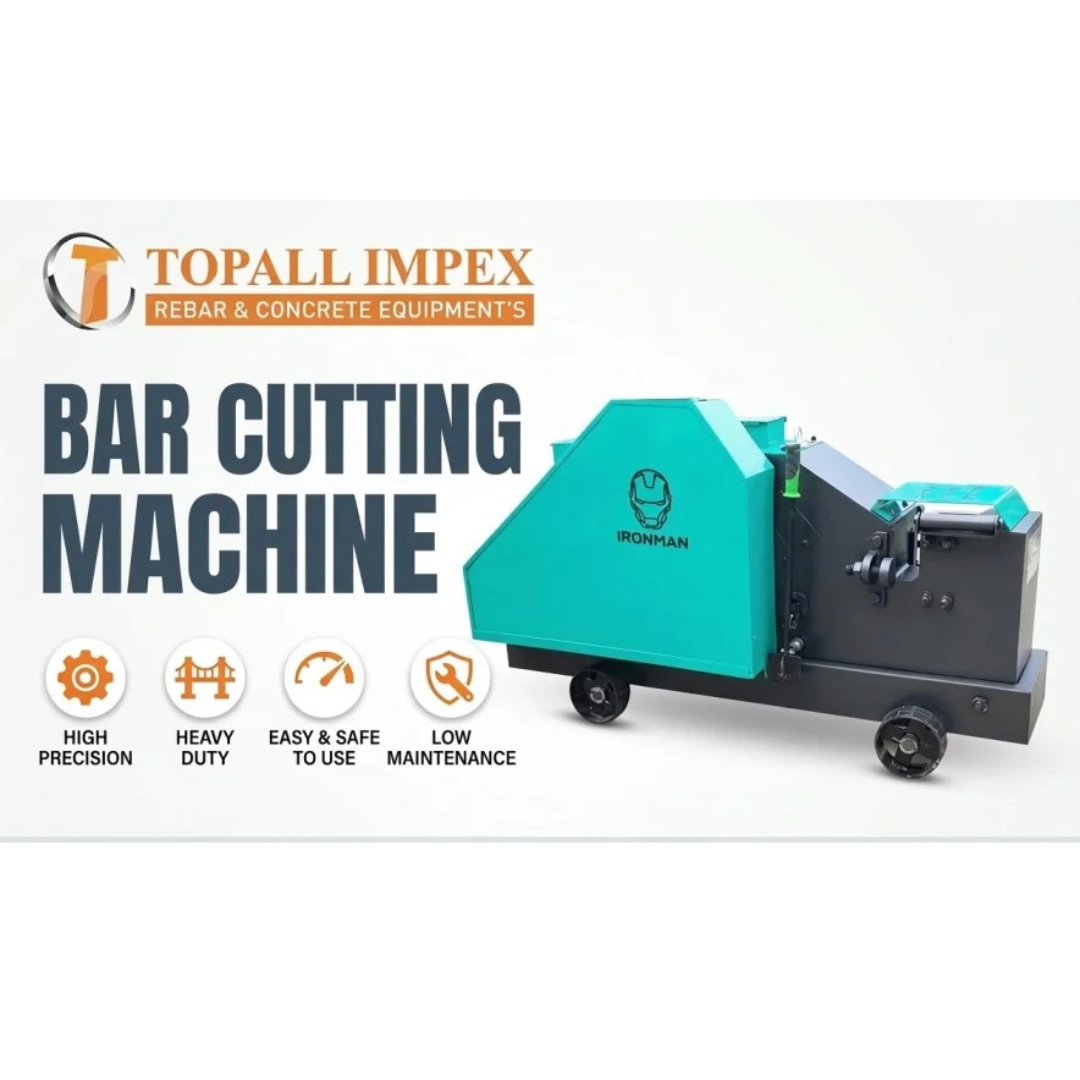
Revolutionize Your Workshop: The Ultimate Bar Cutting Machine Guide - Topall Impex
A bar cutting machine is an electrically powered industrial tool that cuts TMT bars, MS bars, and rebars from 6 mm to 32 mm with precision and speed. It replaces slow, unsafe manual cutting methods used on construction sites and fabrication workshops.
This complete guide by Topall Impex — a trusted bar cutting machine manufacturer, supplier, and dealer based in New Delhi — covers everything a buyer, contractor, or fabricator needs to know. It explains how the machine works, where it is used, essential safety dos and don'ts, and the honest difference between buying new versus second-hand.
The guide also includes a full buyer's checklist, top questions to ask before purchasing, motor power requirements, price ranges across all capacity categories, and 15 frequently asked questions answered clearly.
Whether you need a standalone bar cutter or a bar bending and cutting combination machine, Topall Impex delivers quality-built machines with transparent pricing, manufacturer warranty, genuine spare parts, and pan-India supply — making them the reliable single-point solution for all bar cutting requirements.
What is a Bar Cutting Machine?
A bar cutting machine is an industrial-grade power tool designed to cut steel bars, TMT bars, rebar, and other metal rods to precise lengths with clean, straight cuts. It replaces manual cutting methods — hacksaw, angle grinder, or gas cutting — with a faster, safer, and far more accurate mechanical process.
In simple terms: you feed a steel bar into the machine, set your required length, and the machine cuts it clean — every single time, without wasting material or man-hours.
Bar cutting machines are a backbone tool across construction sites, fabrication workshops, infrastructure projects, and precast concrete manufacturing units. Whether you are cutting a 6 mm mild steel rod or a 32 mm TMT bar, the right bar cutting machine handles it with consistent precision. At Topall Impex, we manufacture and supply bar cutting machines built for the demanding reality of Indian construction and fabrication industries — not for showroom floors.
Key Identity at a Glance:
| Feature | Details |
|---|---|
| Machine Type | Bar Cutting Machine / Steel Bar Cutter |
| Cutting Capacity | 6 mm to 32 mm (TMT, MS, HSD bars) |
| Power Source | Electric Motor (Single Phase / Three Phase) |
| Operation Type | Semi-Automatic / Automatic / Manual |
| Primary Material Cut | TMT Bars, MS Bars, Rebars, Round Bars |
| Common Applications | Construction, Fabrication, Infrastructure |
| Manufacturer | Topall Impex, New Delhi |
| Available As | Bar Cutting Machine / Bar Bending & Cutting Combo |
Why Choose a Bar Cutting Machine?
If you are still cutting steel bars manually on your site or workshop, you are losing time, money, and worker safety every single day. Here is why switching to a bar cutting machine is a decision that pays for itself quickly.
1. Speed and Productivity A bar cutting machine cuts a 16 mm TMT bar in under 3 seconds. A worker using a manual hacksaw takes several minutes for the same cut. On a large construction project where hundreds of bars are cut daily, this speed difference is enormous.
2. Dimensional Accuracy Manual cutting introduces human error. A bar cutting machine delivers the same cut length repeatedly — to the millimetre. This is critical in structural reinforcement work where incorrect bar lengths lead to wastage and structural compromise.
3. Worker Safety Manual cutting with grinders or gas torches creates sparks, heat, and physical strain. A bar cutting machine encloses the cutting action and removes the direct risk exposure for the operator.
4. Clean, Burr-Free Cuts The cutting blade on a quality bar cutting machine produces clean, square ends — no jagged edges, no burrs, no rework needed before use.
5. Reduced Material Wastage Accurate cuts mean bars are used to their full potential. There is less off-cut scrap, which directly saves material cost on large projects.
6. Low Maintenance Modern bar cutting machines from manufacturers like Topall Impex are built with heavy-duty components that require minimal upkeep — blade replacement and periodic lubrication are the primary maintenance needs.
7. Cost Efficiency Over Time The upfront investment in a bar cutting machine delivers long-term savings in labour cost, material wastage, and project delays.
Where is a Bar Cutting Machine used for ?
Bar cutting machines are found wherever steel reinforcement is used. The range of applications is broader than most people realise.
Construction Industry The most common use. On residential, commercial, and industrial construction sites, bar cutting machines cut TMT and HSD steel bars for columns, beams, slabs, foundations, and retaining walls.
Fabrication Workshops Steel fabrication units use bar cutting machines to cut mild steel and stainless steel round bars for gates, grilles, frames, structural assemblies, and custom fabrication jobs.
Infrastructure Projects Roads, bridges, flyovers, metro rail projects, dams, and drainage systems all require extensive steel reinforcement. Bar cutting machines are essential on such large-scale infrastructure sites.
Precast Concrete Manufacturing Precast panel manufacturers cut steel bars to fixed, repeating lengths in high volumes. A bar cutting machine with an automatic stop mechanism is ideal for this application.
Shipbuilding and Heavy Engineering Structural steel bars used in ship hulls and heavy machinery frames are cut using industrial bar cutting machines.
Railway and Utility Projects Track work, pole foundations, and utility infrastructure require precise bar cutting at scale.
Wire Drawing and Rolling Mills Rolled steel bars are cut to standard lengths before packaging and distribution.
If steel bars exist in your workflow, a bar cutting machine belongs in your facility.
How does Bar Cutting Machine Work?
Understanding the working principle of a bar cutting machine helps you operate it correctly and troubleshoot minor issues without external help.
Step 1 — Power Input The machine connects to a single-phase or three-phase electric supply depending on its motor rating. When switched on, the electric motor begins to run.
Step 2 — Flywheel and Eccentric Mechanism The motor drives a flywheel through a belt-pulley arrangement. The flywheel stores rotational energy and maintains smooth, consistent cutting force even under load.
Step 3 — Crank and Connecting Rod The flywheel connects to a crank mechanism. As the flywheel rotates, the crank converts rotational motion into a linear, reciprocating motion — this is what drives the cutting blade up and down.
Step 4 — Fixed and Movable Blades The bar cutting machine has two hardened steel blades — one fixed and one movable. The steel bar rests against the fixed blade. When the operator engages the cutting cycle, the movable blade descends with force and shears the bar cleanly against the fixed blade.
Step 5 — Bar Feeding and Length Setting The operator feeds the steel bar through the guide channel. A stop gauge or measuring scale is used to set the required cut length. Once positioned, the cutting cycle is triggered.
Step 6 — Cut and Eject The blade completes the shear cut in one downward stroke. The cut piece falls away. The operator advances the bar to the next cut position and repeats.
Key Working Components:
- Electric Motor (1.5 HP to 5.5 HP depending on capacity)
- Flywheel
- Belt and Pulley Drive
- Eccentric Crank Mechanism
- Fixed Blade (hardened steel)
- Movable Blade (hardened steel)
- Guide Channel / Bar Rest
- Stop Gauge / Measuring Scale
- Safety Guard / Blade Cover
- ON/OFF Switch and Foot Pedal (in some models)
Key Features of Modern Bar Cutting Machines
Modern bar cutting machines have revolutionized the way workshops operate, offering an array of features designed to enhance precision, efficiency, and safety. One of the standout features of these machines is their superior accuracy. Advanced bar cutting machines are equipped with digital controls and programmable settings that allow users to make precise cuts with minimal effort. This high level of accuracy not only ensures consistent results but also reduces material wastage, which is a significant cost-saving factor in any workshop.
Another key feature is the durability and robustness of these machines. Built with high-quality materials, modern bar cutting machines are designed to withstand the rigors of daily use in demanding workshop environments. The incorporation of hardened steel blades and robust motor systems ensures that these machines can handle a variety of materials, including steel, aluminum, and other metals, without compromising on performance. Moreover, many models come with enhanced cooling systems to prevent overheating, thereby extending the lifespan of the machine.
Safety is a paramount concern in any workshop, and modern bar cutting machines do not disappoint in this regard. These machines come with a host of safety features such as emergency stop buttons, blade guards, and automatic shut-off mechanisms. Some advanced models also include sensors that detect irregularities and halt operations to prevent accidents. These safety features not only protect the operator but also contribute to a safer working environment overall. With these cutting-edge features, modern bar cutting machines are indispensable tools for any professional workshop.
Types of Bar Cutting Machine
Bar cutting machines come in various types, each designed to meet specific needs and applications in a workshop setting. The most common type is the manual bar cutting machine, which is ideal for small-scale operations or DIY enthusiasts. These machines are relatively simple to operate and do not require a power source, making them highly portable. Manual bar cutting machines are perfect for cutting smaller bars and rods, and they offer a cost-effective solution for workshops on a budget.
Hydraulic bar cutting machines are another popular choice, particularly in industrial and large-scale workshop settings. These machines use hydraulic power to generate the force needed to cut through thick and hard materials with ease. Hydraulic bar cutting machines are known for their efficiency and ability to handle high-volume cutting tasks. They come equipped with powerful motors and advanced control systems that allow for precise adjustments, making them suitable for cutting a wide range of materials, including steel, aluminum, and copper.
For those seeking the utmost in precision and automation, CNC (Computer Numerical Control) bar cutting machines are the way to go. These highly advanced machines are operated via computer programs that control the cutting process with unparalleled accuracy. CNC bar cutting machines are capable of executing complex cuts and patterns with minimal human intervention. They are ideal for large-scale production environments where consistency and precision are crucial. While they come with a higher price tag, the investment is often justified by the increased productivity and reduced labor costs they offer.
Benefits of Using a Bar Cutting Machine in Your Workshop
Incorporating a bar cutting machine into your workshop can bring numerous benefits that enhance both productivity and the quality of your work. One of the most significant advantages is the increased efficiency that these machines provide. With the ability to make quick and precise cuts, bar cutting machines drastically reduce the time it takes to complete projects. This allows you to take on more work and meet deadlines with ease, ultimately boosting your workshop's overall output.
Another notable benefit is the improved accuracy and consistency that bar cutting machines offer. Unlike manual cutting methods, which are prone to human error, these machines deliver precise cuts every time. This level of accuracy is particularly important in projects that require tight tolerances and exact measurements. By ensuring consistent results, bar cutting machines help maintain the quality of your work, which can lead to higher customer satisfaction and repeat business.
Safety is another critical advantage provided by bar cutting machines. Equipped with various safety features such as blade guards, emergency stop buttons, and automatic shut-off mechanisms, these machines significantly reduce the risk of accidents and injuries in the workshop. This not only protects the operator but also creates a safer working environment for everyone. Additionally, the reduced physical effort required to operate these machines minimizes the risk of strain and fatigue, allowing for longer and more productive work sessions.
How to Choose the Right Bar Cutting Machine
Selecting the right bar cutting machine for your workshop involves considering several key factors to ensure that you make an informed decision. The first and foremost factor to consider is the type of materials you will be cutting. Different machines are designed to handle different materials, so it's crucial to choose one that is compatible with the materials you work with most frequently. For example, if you primarily work with steel, you'll need a machine that can handle the hardness and thickness of steel bars.
Another important consideration is the volume of work you anticipate. If you run a small workshop with occasional cutting needs, a manual or portable bar cutting machine may suffice. However, for larger workshops or industrial settings where high-volume cutting is required, a hydraulic or CNC bar cutting machine would be more appropriate. These machines offer greater efficiency and can handle continuous operation without compromising on performance.
Budget is also a critical factor in the decision-making process. While it's tempting to go for the most advanced model available, it's essential to balance cost with functionality. Determine your budget and look for machines that offer the best value for money within that range. Remember to consider the long-term benefits and potential cost savings in terms of reduced labor, increased productivity, and lower maintenance costs. Additionally, it's worth checking for warranty options and after-sales support, as these can provide added peace of mind and protection for your investment.
Essential Safety Tips for Operating Bar Cutting Machines
Operating bar cutting machines safely is paramount to prevent accidents and ensure a secure working environment. One of the most important safety tips is to always wear appropriate personal protective equipment (PPE). This includes safety goggles to protect your eyes from flying debris, gloves to safeguard your hands, and ear protection to shield your hearing from the noise generated by the machine. Wearing sturdy, non-slip footwear is also advisable to prevent slips and falls.
Before operating the machine, it's crucial to conduct a thorough inspection to ensure that all components are in good working condition. Check for any signs of wear or damage, particularly on the blades and safety guards. Make sure that all bolts and screws are tightened securely and that the machine is properly lubricated. If you notice any issues, address them immediately before proceeding with the operation. Regular maintenance checks can go a long way in preventing accidents and ensuring the longevity of the machine.
During operation, always adhere to the manufacturer's guidelines and instructions. Avoid making any modifications to the machine, as this can compromise its safety features. Keep your hands and other body parts away from the cutting area, and never attempt to remove cut pieces or debris while the machine is running. Use tools such as push sticks or brushes to clear any obstructions safely. Additionally, make sure that the work area is well-lit and free from clutter to prevent tripping hazards. By following these safety tips, you can minimize the risk of accidents and create a safer working environment for everyone.
Maintenance and Care for Optimal Performance
Proper maintenance and care are essential to ensure the optimal performance and longevity of your bar cutting machine. One of the most critical maintenance tasks is to regularly inspect and clean the machine. Dust, debris, and metal shavings can accumulate on the machine's components, leading to wear and reduced efficiency. Use a brush or compressed air to clean the machine thoroughly after each use, paying particular attention to the blades, motor, and moving parts.
Lubrication is another vital aspect of maintaining your bar cutting machine. Regularly lubricate the moving parts, such as the bearings and gears, to reduce friction and prevent wear. Use the recommended lubricant specified by the manufacturer, and follow the lubrication schedule outlined in the user manual. Proper lubrication not only ensures smooth operation but also extends the lifespan of the machine's components.
It's also important to regularly check and replace worn or damaged parts. Blades, in particular, can become dull or chipped over time, affecting the quality of the cuts and putting additional strain on the machine. Inspect the blades regularly and replace them as needed to maintain optimal cutting performance. Additionally, keep an eye on other critical components, such as belts, hoses, and electrical connections, and address any issues promptly. By staying on top of maintenance and care, you can ensure that your bar cutting machine continues to operate efficiently and reliably for years to come.
Signs That Your Bar Cutting Machine Spare Part Needs Replacement
By Topall Impex | Bar Cutting Machine Manufacturer, New Delhi
Most bar cutting machine breakdowns do not happen suddenly. The machine warns you well in advance. The problem is — most operators and site supervisors miss the early warning signs or ignore them until the machine stops working completely. That unplanned downtime costs you more than just repair money. It costs you project delays, labour idle time, and in some cases — worker safety. This guide by Topall Impex helps you identify exactly when a specific spare part on your bar cutting machine is telling you it needs replacement — before it fails completely.
1. Cutting Blade — Signs It Needs Replacement
The cutting blade is the most frequently replaced spare part on any bar cutting machine. It takes the full force of every cut and wears down over time.
Watch for these signs:
Unclean or Jagged Cuts When your machine starts producing rough, uneven, or jagged cut ends instead of clean, square cuts — the blade edge has worn down. A sharp blade shears steel cleanly. A dull blade crushes and tears it.
Increased Cutting Effort or Slower Cycle If the cutting cycle feels heavier than usual or the machine takes noticeably longer to complete each cut, the blade is working harder to compensate for lost sharpness.
Visible Chipping or Cracking on the Blade Edge Inspect the blade edge visually before each shift. Any visible chips, cracks, or deformations on the cutting edge mean the blade must be replaced immediately — a cracked blade can fracture during operation.
Burrs and Excess Material on Cut Ends Excessive burrs on cut bar ends are a direct indicator of blade wear. Clean, sharp blades leave minimal to no burr. Heavy burring means the blade is no longer cutting — it is tearing.
Blade Tip Discolouration or Heat Marks Blue or black discolouration on the blade tip indicates overheating caused by increased friction from a dull cutting edge. This accelerates further blade damage and should not be ignored.
2. Flywheel Belt — Signs It Needs Replacement
The belt connects the motor to the flywheel and transfers power throughout the cutting cycle. A worn belt affects the entire machine performance.
Watch for these signs:
Slipping During the Cutting Stroke If the machine hesitates, slows, or loses power mid-cut — especially on larger diameter bars — the belt is slipping on the pulley. This means the belt has stretched or its surface has glazed over from heat and age.
Squealing or Squeaking Noise During Operation A high-pitched squeal when the machine runs is a classic sign of belt slippage or a belt that has hardened and lost its grip on the pulley surface.
Visible Cracks, Fraying, or Glazing on the Belt Inspect the belt surface regularly. Cracks across the belt width, frayed edges, or a shiny, hardened surface (glazing) all indicate a belt that is near the end of its service life.
Vibration Increase During Operation An uneven or partially damaged belt creates irregular tension during rotation, which increases machine vibration. If your machine is vibrating more than usual, inspect the belt.
Belt Misalignment If the belt repeatedly slips off the pulley or rides to one side, the belt has either stretched unevenly or the pulley alignment has shifted. Both conditions require immediate attention.
3. Fixed and Movable Blade Holders — Signs They Need Replacement
The blade holders secure the cutting blades in precise alignment. Worn holders affect cut quality and blade life.
Watch for these signs:
Blade Movement or Play During Cutting The blade should be completely rigid during the cutting stroke. If you notice the blade shifting, rocking, or rattling during operation, the blade holder has worn and can no longer hold the blade securely.
Inconsistent Cut Angles When cut ends start coming out at slightly off angles instead of perfectly square, the blade holder alignment has shifted due to wear. This is especially noticeable when cutting larger diameter bars.
Difficulty Securing the Blade If the blade fixing bolts no longer tighten the blade firmly, the holder threads or seating surfaces have worn. Do not operate the machine with a loosely held blade.
4. Eccentric Shaft and Bearings — Signs They Need Replacement
The eccentric shaft converts flywheel rotation into the cutting stroke. The bearings support this shaft under high, repeated load.
Watch for these signs:
Knocking or Thumping Sound During Operation A knocking sound — especially one that repeats with each cutting cycle — is the most direct sign of worn eccentric shaft bearings. This sound means metal-to-metal contact is occurring where smooth bearing surfaces should be.
Increased Machine Vibration Worn bearings on the eccentric shaft create imbalance in the cutting mechanism, which translates into increased vibration throughout the machine frame.
Heat Build-Up Near the Shaft Housing Touch the shaft housing area after the machine has been running for some time. Excessive heat in this area indicates bearing friction from wear or insufficient lubrication — both require immediate inspection.
Looseness or Play in the Crank Mechanism If you can manually detect any looseness or play in the crank assembly when the machine is switched off, the bearings or shaft journals have worn beyond acceptable limits.
5. Guide Channel — Signs It Needs Replacement
The guide channel holds and aligns the steel bar during feeding. Wear in the guide channel directly affects cut accuracy.
Watch for these signs:
Bar Movement or Rattling During Feed The bar should move smoothly and hold firmly in the guide channel. If you notice the bar rattling, shifting laterally, or sitting loosely — the channel walls have worn and no longer provide proper support.
Inaccurate Cut Lengths If bars are consistently coming out slightly longer or shorter than the set measurement, the guide channel wear is allowing bar movement before and during the cut.
Visible Wear Grooves Inside the Channel Inspect the interior of the guide channel for deep wear grooves or scoring caused by repeated bar friction. Deep grooves compromise bar alignment and need to be addressed.
6. Motor — Signs It Needs Attention or Replacement
The electric motor is the power source of the entire machine. Motor issues affect all functions simultaneously.
Watch for these signs:
Machine Starting Slowly or Struggling to Reach Full Speed A healthy motor reaches operating speed quickly. If the machine starts sluggishly or struggles to build up to normal operating speed, the motor windings, capacitor, or bearings are deteriorating.
Motor Running Hot All motors generate some heat during operation. However, if the motor casing becomes too hot to touch comfortably after normal operation, it indicates overloading, winding damage, or cooling fan failure.
Burning Smell During Operation A burning smell — especially one that resembles heated electrical insulation — from the motor area means the windings are overheating. Stop the machine immediately and have the motor inspected.
Humming Without Starting If the motor hums but the machine does not start or the flywheel does not turn, the starting capacitor (on single-phase motors) has failed and needs replacement.
Tripping the Circuit Breaker Repeatedly A motor that repeatedly trips the circuit breaker is drawing more current than rated — indicating internal damage, winding faults, or a mechanical jam putting excess load on the motor.
7. Stop Gauge / Measuring Scale — Signs It Needs Replacement
The stop gauge sets the cut length for each bar. An inaccurate gauge directly causes material wastage and rework.
Watch for these signs:
Consistently Incorrect Cut Lengths If bars are cutting long or short despite setting the gauge correctly, the gauge has either shifted in its mounting, the scale markings have worn off, or the stop mechanism has developed play.
Loose or Wobbly Stop Gauge Arm The stop gauge arm must hold firm and rigid at the set position. Any looseness in the arm means the locking mechanism has worn and the arm moves slightly during bar impact — producing inaccurate lengths.
8. Safety Guard — Signs It Needs Replacement
The blade safety guard is a non-negotiable safety component. It must always be in perfect condition.
Watch for these signs:
Cracks, Bends, or Deformation Any physical damage to the safety guard — cracks, bends, missing sections — means it must be replaced before the machine is used again. A damaged guard cannot contain blade fragments in the event of blade failure.
Guard Does Not Seat or Lock Properly If the guard no longer fits securely in its mounting position or the locking mechanism is damaged, it must be repaired or replaced. Operating without a properly secured guard is never acceptable.
Quick Reference — Spare Part Replacement Warning Signs
| Spare Part | Key Warning Sign |
|---|---|
| Cutting Blade | Jagged cuts, burrs, visible chipping |
| Flywheel Belt | Squealing, slipping, visible cracks |
| Blade Holders | Blade play, off-angle cuts |
| Eccentric Shaft Bearings | Knocking sound, excess heat, vibration |
| Guide Channel | Bar rattling, inaccurate cut lengths |
| Electric Motor | Slow start, burning smell, tripping breaker |
| Stop Gauge | Consistently wrong cut lengths |
| Safety Guard | Cracks, deformation, loose fitting |
What to Do When You Notice These Signs
Step 1 — Stop the machine immediately. Do not continue operating a machine showing warning signs. Continued use accelerates damage and increases the risk of sudden failure or operator injury.
Step 2 — Identify the specific part showing the sign. Use this guide to pinpoint which component is giving you the warning. A clear diagnosis saves time and prevents unnecessary part replacement.
Step 3 — Contact your machine manufacturer for genuine spare parts. Always replace worn parts with genuine, manufacturer-specified spares. Third-party parts of incorrect specification shorten machine life and can create safety issues.
Step 4 — Do not resume operation until the replacement is complete and verified. After replacing the spare part, run the machine without load for a short period to confirm correct operation before returning to full production.
Why Genuine Spare Parts Matter
Using genuine spare parts from your machine manufacturer — not unspecified market substitutes — is the single most important factor in maintaining machine performance and operator safety. Genuine parts are manufactured to the exact specification of your machine. They fit correctly, perform as designed, and maintain the integrity of every other component they interact with. A substandard blade, for example, does not just cut poorly — it puts excess load on the blade holder, eccentric shaft, and motor simultaneously. At Topall Impex, we stock genuine spare parts for all bar cutting machines we manufacture. Our team can advise on the correct specification for your model and dispatch parts promptly to minimise your downtime.
Choose Topall Impex For Bar Cutting Machine/ Bar Cutting Machine Spare Parts At Best Price in Delhi
Your bar cutting machine communicates clearly when a spare part is reaching the end of its service life. Unusual sounds, vibration, poor cut quality, heat build-up, and inconsistent performance are all messages the machine sends before a failure occurs. Acting on these early warning signs — rather than waiting for a complete breakdown — is the difference between a short, planned maintenance stop and a costly, unplanned project shutdown. Inspect your machine regularly. Replace parts at the first reliable sign of wear. Use genuine spares. And when in doubt, consult your manufacturer directly. For genuine spare parts, technical support, and maintenance guidance for bar cutting machines — contact Topall Impex, New Delhi. Topall Impex — Bar Cutting Machine Manufacturer, Supplier & Dealer | New Delhi, India
Do's And Don't with Bar Cutting Machine
Following the correct operating practices protects your machine, your material, and most importantly — your workers.
DO's ✅
- Do read the operator manual before first use. Every machine has specific operating parameters. Understanding them prevents early damage and safety incidents.
- Do check blade condition before every shift. A worn or chipped blade produces unclean cuts and puts extra load on the motor. Replace blades at the first sign of wear.
- Do use the correct machine for the bar diameter. If your machine is rated for up to 25 mm bars, do not attempt to cut 32 mm bars through it. This damages the blades and can crack the machine frame.
- Do keep the cutting zone clean and clear. Remove off-cuts and scrap regularly. A cluttered cutting area leads to misfeed and operator accidents.
- Do lubricate moving parts at regular intervals. Eccentric shafts, blade holders, and guide channels require periodic lubrication as per the manufacturer's schedule.
- Do use PPE — safety glasses, steel-toed boots, and gloves. Even a well-guarded machine can throw small chips during cutting.
- Do ensure stable machine placement. The machine must sit on a level, stable surface. Vibration on an unstable base accelerates wear and creates misalignment.
- Do shut down the machine before clearing jams or adjusting blades. Never put your hands near the blade area while the motor is running.
DON'Ts ❌
- Don't cut bars larger than the rated capacity. This is the most common cause of blade breakage and motor burnout.
- Don't operate the machine with guards removed. Safety guards exist to contain blade fragments and protect the operator. Running without guards is never acceptable.
- Don't allow untrained workers to operate the machine. Bar cutting machines require operator training. Unskilled use leads to both poor output quality and serious injury risk.
- Don't ignore unusual noises or vibrations. If the machine sounds different — clicking, grinding, or excessive vibration — stop it and inspect before continuing.
- Don't use damaged or incorrect-specification blades. Always replace with manufacturer-recommended blade specifications. Using wrong-grade blades leads to poor cuts and blade failure.
- Don't leave the machine unattended while running. The operator must remain present and attentive during the entire operation.
- Don't allow children or unauthorised personnel near the machine. Restrict access to the machine area to trained operators only.
New vs Second-Hand Bar Cutting Machine — Pros and Cons - Which One is Good
This is one of the most common buying decisions buyers face. Here is an honest, practical breakdown.
New Bar Cutting Machine
Pros:
- Full manufacturer warranty (typically 12 months)
- All components are new — no hidden wear or damage
- Latest design features and improved safety mechanisms
- Spare parts are readily available from the manufacturer
- Higher resale value if you sell later
- Reliable performance from day one
- AMC (Annual Maintenance Contract) options available
- Manufacturer support for installation, commissioning, and training
Cons:
- Higher upfront investment compared to second-hand
Second-Hand Bar Cutting Machine
Pros:
- Lower initial purchase price
- Can be a practical option for short-duration projects with tight budgets
Cons:
- Unknown usage history — worn blades, stressed motor, cracked frame
- No warranty or manufacturer support
- Higher risk of unexpected breakdowns and repair costs
- Spare parts may be difficult to source if the model is discontinued
- Reduced safety reliability — old machines may lack current safety features
- Hidden repair costs can quickly exceed the price difference over a new machine
- No documentation, calibration records, or service history
Which One Should You Buy?
For businesses, contractors, and fabricators who use the machine regularly, a new bar cutting machine is always the better investment. The warranty, reliability, spare part availability, and manufacturer support make the total cost of ownership significantly lower than a second-hand machine.
A second-hand machine makes sense only if you have a single, short-duration project and the machine is inspected thoroughly by a qualified technician before purchase.
Topall Impex supplies new bar cutting machines at competitive prices — making the cost difference between new and used far smaller than most buyers assume.
Common Mistakes to Avoid When Using a Bar Cutting Machine
When using a bar cutting machine, it's important to be aware of common mistakes that can compromise safety and performance. One of the most frequent errors is using the wrong type of blade for the material being cut. Different materials require different blade types, and using the incorrect blade can result in poor cuts, excessive wear on the machine, and even accidents. Always ensure that you are using the appropriate blade for the material and replace it when it becomes dull or damaged.
Another common mistake is neglecting to secure the material properly before cutting. Failing to clamp the bar securely can lead to inaccurate cuts and pose a significant safety risk. Make sure that the material is firmly clamped in place and that it cannot move during the cutting process. This not only ensures precise cuts but also prevents the material from shifting or slipping, which can cause the blade to bind or kick back.
Improper maintenance is another pitfall to avoid. Skipping regular maintenance checks and neglecting to clean and lubricate the machine can lead to reduced performance and increased wear on components. Follow the manufacturer's maintenance schedule and perform routine inspections to keep the machine in optimal condition. Additionally, avoid overloading the machine by trying to cut materials that exceed its capacity. Overloading can strain the motor and other components, leading to premature wear and potential breakdowns. By avoiding these common mistakes, you can ensure safe and efficient operation of your bar cutting machine.
Top Questions to Ask Before Buying a Bar Cutting Machine — Complete Guide by Topall Impex
Before you spend money on a bar cutting machine, get clear answers to these questions. They protect your investment and ensure you buy the right machine.
1. What is the maximum bar diameter I will be cutting? This determines the machine's required cutting capacity. Always buy a machine with a capacity slightly above your current maximum — it gives you headroom for future requirements.
2. What type of steel bars will I be cutting? TMT bars, MS bars, HSD bars, and stainless steel bars have different hardness levels. Confirm that the machine is suitable for your specific material type.
3. What is the expected daily cutting volume? If you are cutting 500+ bars per day, you need a heavy-duty machine with a higher-rated motor and a robust blade assembly. Light-duty machines will wear out quickly under heavy use.
4. Do I need a standalone bar cutting machine or a bar bending and cutting combo? If your workflow also involves bending bars, a combination machine saves space, cost, and setup time.
5. What is the available power supply at my site? Single-phase power (220V) suits smaller machines. Larger machines require three-phase power (440V). Confirm your site supply before selecting a machine.
6. What blades does the machine use and how easily are they available? Blade replacement is a regular maintenance requirement. Confirm that replacement blades are standard, readily available, and competitively priced.
7. What warranty does the manufacturer offer? A minimum 12-month warranty on parts and workmanship is standard. Ask specifically what is and is not covered.
8. Is after-sales service available in my location? A machine without accessible service support is a liability. Confirm the manufacturer or dealer has service capability in your area.
9. What is the machine's weight and footprint? For sites where the machine needs to be moved frequently, weight and portability matter. Confirm the machine dimensions fit your available workspace.
10. Are genuine spare parts stocked and available promptly? Downtime during spare part procurement is lost productivity. Choose a manufacturer that stocks parts and can dispatch them quickly.
What to Check Before Buying a Bar Cutting Machine — Complete Buyer's Checklist
Use this checklist when evaluating any bar cutting machine before purchase.
Machine Specifications
- Cutting capacity matches your maximum bar diameter requirement
- Motor power rating is appropriate for your daily cutting volume
- Machine is rated for the type of steel bars you will cut
- Single-phase or three-phase power supply matches your site
Build Quality
- Machine frame is cast iron or heavy-gauge fabricated steel — no plastic or light sheet metal construction
- Blades are hardened steel with clearly stated grade specification
- All moving parts have proper guards and enclosures
- Blade adjustment and replacement mechanism is accessible and simple
Safety Features
- Blade guard is present and securely fitted
- Emergency stop or foot pedal is functional
- Guide channel holds bars firmly during the cut
- Motor overload protection is built in
Manufacturer Credentials
- Manufacturer has verifiable experience and an established track record
- Machine carries relevant certifications or compliance marks
- Manufacturer provides technical documentation and operator manual
- Contact details, physical address, and after-sales support are clearly stated
Commercial Terms
- Written warranty with clear terms
- Spare parts availability confirmed
- Delivery timeline and packaging standard confirmed
- Invoice, GST compliance, and after-sale documentation in order
Top Bar Cutting Machine Manufacturers & Dealers in Delhi
Delhi is one of India's most active construction and infrastructure markets. From residential high-rises in Dwarka to metro rail infrastructure across the NCR, demand for reliable bar cutting machines in Delhi remains consistently high. Choosing the right manufacturer or dealer — and the right machine — directly impacts your project speed, cut quality, and overall cost. This guide gives you a complete, honest overview of the top bar cutting machine manufacturers and dealers in Delhi, the most recommended machines for construction work, and why Topall Impex stands out as a trusted manufacturing partner.
1. Topall Impex — Best Bar Cutting Machine Manufacturer, New Delhi
Established: Long-standing presence in Delhi's steel machinery manufacturing sector Specialisation: Steel Bar Cutting Machines, Bar Bending Machines, Bar Bending & Cutting Combination Machines Cutting Capacity: 6 mm to 32 mm — TMT Bars, MS Bars, HSD Bars Location: New Delhi
Topall Impex is a direct manufacturer of bar cutting machines — not a reseller or trader. Every machine leaves our facility built to handle real Indian construction site conditions: variable power supply, dusty environments, continuous high-volume use, and demanding project timelines.
Why buyers across Delhi choose Topall Impex:
- Direct manufacturer pricing — no middleman markup
- Heavy cast iron frame construction for long service life
- Hardened steel blades rated for TMT, MS, and HSD bars
- Single-phase and three-phase motor options
- Genuine spare parts stocked and available for prompt dispatch
- Written warranty with transparent terms
- GST-compliant invoicing and full after-sales support
- Pan-India supply from our New Delhi base
- Bar bending and cutting combination machines available as a single-unit solution
Whether you are a construction contractor, fabrication workshop, infrastructure company, or hardware dealer, Topall Impex gives you direct manufacturer accountability from purchase through the machine's entire working life.
Contact Topall Impex for pricing, specifications, and availability.
2. Sona Construction Technologies Pvt Ltd
Years in Business: 41 years Popular Models: GQ40, GQ50 Specialisation: Construction machinery including bar cutting equipment
Sona Construction Technologies is one of the older names in Delhi's construction machinery market. With over four decades in the business, they supply GQ40 and GQ50 bar cutting machines to construction contractors and dealers across the region.
3. Alpha Equipments
Years in Business: 18 years Popular Models: GQ-40, GQ-50 Specialisation: Bar cutting machines for construction and fabrication
Alpha Equipments has built a steady customer base over 18 years supplying GQ-series bar cutting machines in Delhi. They cater primarily to construction contractors and site procurement buyers.
4. Shanti Engineering Co
Years in Business: 28 years Popular Models: Semi-Automatic and Fully Automatic bar cutting machines Specialisation: Automation-focused bar cutting solutions
With 28 years of market presence, Shanti Engineering Co focuses on semi-automatic and fully automatic bar cutting machines — making them a relevant option for fabrication units and precast manufacturers where automated, high-volume cutting is required.
5. Avak Impex
Popular Models: GQ-32mm, GQ-50A Area of Operation: Chawri Bazar, Ashok Vihar Specialisation: GQ-series bar cutting machines
Avak Impex operates in two of Delhi's most established industrial and hardware trading hubs — Chawri Bazar and Ashok Vihar. They stock GQ-32mm and GQ-50A models and serve local buyers in these markets.
6. Subhi Enterprises
Popular Models: TMT Bar Cutting Machine GQ40-ES, GQ40I Specialisation: TMT bar cutting machines for construction
Subhi Enterprises supplies TMT-specific bar cutting machines and serves construction buyers looking for GQ40-series machines with different motor and specification configurations.
7. Pinnacle Machinery
Popular Models: Pinnacle TMT Bar Cutting Machine GQ40, GQ52 Specialisation: Heavy-duty TMT bar cutting machines
Pinnacle Machinery manufactures its own branded bar cutting machines — the GQ40 and GQ52 — aimed at heavy-duty reinforcement work on construction sites requiring high-capacity cutting.
8. Switeck India
Popular Models: GQ40 Bar Cutting Machine Specialisation: GQ40 series bar cutting machines
Switeck India is known in the Delhi market for GQ40 bar cutting machines and serves contractors and fabricators looking for this widely used model.
9. Fastech Machinery Private Limited
Area of Operation: Rithala, Delhi Cutting Capacity: 6 mm to 50 mm Specialisation: Electric bar cutting machines for heavy-duty applications
Fastech Machinery operates from Rithala and specialises in electric bar cutting machines covering a wide capacity range from 6 mm up to 50 mm — making them relevant for buyers with heavy-gauge cutting requirements.
Quick Comparison — Top Bar Cutting Machine Manufacturers & Dealers in Delhi
| Manufacturer / Dealer | Years Active | Popular Models | Specialisation |
|---|---|---|---|
| Topall Impex | Since 2008 | 6–32 mm TMT Bar Cutter, Combo Machine |
Direct Manufacturer, Full Support |
| Sona Construction Technologies | 41 Years | GQ40, GQ50 | Construction Machinery |
| Alpha Equipments | 18 Years | GQ-40, GQ-50 | Bar Cutting Machines |
| Shanti Engineering Co | 28 Years | Semi/Fully Automatic | Automation Focus |
| Avak Impex | Active | GQ-32mm, GQ-50A | Chawri Bazar / Ashok Vihar |
| Subhi Enterprises | Active | GQ40-ES, GQ40I | TMT Bar Cutting |
| Pinnacle Machinery | Active | GQ40, GQ52 | Heavy-Duty Cutting |
| Switeck India | Active | GQ40 | GQ-Series Machines |
| Fastech Machinery | Active | GQ42, 6–50 mm Range | Heavy Gauge Electric Cutting |
Top 5 Bar Cutting Machine - Most Recommended & Most Used Machines on Delhi Construction Sites
1. GQ40 / GQ40C Steel Bar Cutting Machine — 32 mm Capacity
Why It Is the Most Used Machine in Delhi
The GQ40 is the most widely used bar cutting machine on Delhi construction sites — and for good reason. It covers the 6 mm to 32 mm bar range that accounts for the vast majority of TMT bars used in residential and commercial construction. Its 3 HP to 5 HP motor delivers reliable cutting performance across this full range without being oversized for standard site requirements.
Key Specifications:
- Cutting Capacity: 6 mm to 32 mm
- Motor Power: 3 HP to 5 HP
- Power Supply: Single Phase / Three Phase
- Ideal For: Residential, commercial, and mid-scale infrastructure construction
Best Suited For: Contractors and fabricators handling standard Delhi residential and commercial construction projects where 8 mm to 25 mm TMT bars dominate the cutting requirement.
2. GQ50 Electric Bar Cutting Machine — 6–50 mm Capacity
Why It Is Recommended for Heavy Construction
The GQ50 steps up where the GQ40 reaches its limit. With a 5 HP motor and capacity up to 50 mm, the GQ50 handles the large-diameter bars used in bridge work, flyover construction, heavy foundations, and industrial structures. Suppliers including Sona Construction Technologies stock this model for buyers with heavy-load cutting requirements.
Key Specifications:
- Cutting Capacity: 6 mm to 50 mm
- Motor Power: 5 HP
- Power Supply: Three Phase
- Ideal For: Infrastructure, bridges, industrial construction, heavy foundations
Best Suited For: Infrastructure contractors, civil engineering companies, and heavy construction sites where bars above 32 mm diameter are regularly used.
3. Pinnacle TMT Bar Cutting Machine — GQ52
Why It Is Recommended for Heavy-Duty Reinforcement Work
The Pinnacle GQ52 is a robust, high-capacity bar cutting machine built specifically for heavy-duty reinforcement work. It is rated for cutting larger diameter bars with consistent performance under sustained workload — making it a relevant choice for large-scale projects where the machine runs through multiple shifts.
Key Specifications:
- Cutting Capacity: High-capacity TMT bar cutting
- Build: Heavy-duty frame construction
- Ideal For: Large reinforcement projects, continuous multi-shift operation
Best Suited For: Contractors running large reinforcement projects requiring a machine that sustains high daily cutting volumes without performance drop.
4. Fastech GQ42 Bar Cutting Machine
Why It Is Recommended for High-Speed Cutting
The Fastech GQ42 is a three-phase electric bar cutting machine known for its high-speed cutting performance on heavy-gauge steel. It is particularly popular with buyers who need rapid cycle times on heavy wire and bar stock — cutting large quantities in short windows on active construction sites.
Key Specifications:
- Power Supply: Three Phase
- Specialisation: High-speed cutting of heavy-gauge steel bars and wire
- Ideal For: Rapid, high-volume cutting operations
Best Suited For: Fabrication workshops and construction sites where cutting speed and throughput per shift are the primary performance requirement.
5. Unicorn UNI 50C Bar Cutting Machine — 40–50 mm Capacity
Why It Is Recommended for High-Torque Applications
The Unicorn UNI 50C is favoured on construction sites where high-torque cutting performance on large-diameter bars is the primary need. Its 40 mm to 50 mm capacity range and torque-optimised motor make it a reliable choice for heavy reinforcement work where standard GQ40-class machines fall short.
Key Specifications:
- Cutting Capacity: 40 mm to 50 mm
- Specialisation: High-torque performance on large bars
- Ideal For: Heavy reinforcement, large structural projects
Best Suited For: Infrastructure contractors and heavy civil construction companies cutting predominantly large-diameter bars on demanding project sites.
Top 5 Most Recommended Bar Cutting Machines — At a Glance
| Rank | Machine Model | Cutting Capacity | Motor Power | Best For |
|---|---|---|---|---|
| 1 | GQ40 / GQ40C | 6–32 mm | 3–5 HP | Standard construction sites |
| 2 | GQ50 | 6–50 mm | 5 HP | Heavy infrastructure projects |
| 3 | Pinnacle GQ52 | High-capacity | Heavy-duty | Large reinforcement work |
| 4 | Fastech GQ42 | Heavy gauge | Three Phase | High-speed cutting |
| 5 | Unicorn UNI 50C | 40–50 mm | High Torque | Large-diameter bar cutting |
How to Choose the Right Bar Cutting Machine in Delhi
With multiple manufacturers, dealers, and machine models available in Delhi, use these four criteria to narrow your decision.
1. Match the Machine Capacity to Your Bar Size The GQ40 covers 90% of standard construction requirements up to 32 mm. If you regularly cut bars above 32 mm, move to the GQ50 or UNI 50C range.
2. Assess Your Daily Cutting Volume High daily volumes require machines with heavier motor ratings and more robust blade assemblies. Do not undersize the machine to save on upfront cost — it will cost more in wear and downtime.
3. Buy from a Manufacturer, Not Just a Dealer A direct manufacturer like Topall Impex gives you warranty accountability, genuine spare parts, and technical support that a trading dealer cannot match.
4. Confirm After-Sales Service Availability A machine is only as good as the support behind it. Confirm that the manufacturer or dealer can service your machine and supply spare parts promptly in Delhi and your project locations.
Why Topall Impex is the Right Choice Among Delhi's Bar Cutting Machine Manufacturers
Among all the manufacturers and dealers listed in this guide, Topall Impex is the only direct manufacturer that combines all of the following in one place:
- In-house manufacturing — not trading or reselling
- Full 6 mm to 32 mm cutting capacity range
- Heavy cast iron frame and hardened steel blade construction
- Genuine spare parts stocked and readily available
- Written warranty with transparent terms
- Bar bending and cutting combination machines available
- Competitive, transparent pricing with GST-compliant invoicing
- Direct after-sales support from the manufacturer
- Pan-India supply from New Delhi
When you buy from Topall Impex, you deal directly with the people who built your machine — giving you complete accountability from day one through the machine's full working life.
Address - Aggarwal Cyber Plaza, 784, II, Netaji Subhash Place, Pitampura, New Delhi, Delhi 110034
Contact Topall Impex For Bar Cutting Machine GQ40 - GQ52 At Best Price in Delhi
Delhi's construction and fabrication industry runs on reliable bar cutting machines. Knowing who manufactures and supplies these machines — and which models are genuinely proven on Delhi's construction sites — puts you in a position to make a confident, informed purchase decision.
The GQ40 remains the most widely used machine for standard construction work. For heavier applications, the GQ50 and UNI 50C deliver the capacity and torque required. For buyers who prioritise manufacturer accountability, genuine spare parts, and direct support, Topall Impex is the clear first choice among Delhi's bar cutting machine manufacturers.
For specifications, current pricing, and availability — contact Topall Impex today. Topall Impex — Bar Cutting Machine Manufacturer, Supplier & Dealer | New Delhi, India
Bar Cutting Machine Price in India
Bar cutting machine prices in India vary depending on the cutting capacity, motor power, build quality, and manufacturer. Here is a general reference range to help you budget.
| Machine Type | Cutting Capacity | Approximate Price Range |
|---|---|---|
| Light-Duty Bar Cutter | Up to 16 mm | ₹15,000 – ₹30,000 |
| Medium-Duty Bar Cutter | Up to 25 mm | ₹30,000 – ₹55,000 |
| Heavy-Duty Bar Cutter | Up to 32 mm | ₹55,000 – ₹1,20,000 |
| Bar Bending & Cutting Combo | 6–32 mm | ₹70,000 – ₹1,80,000 |
Factors that affect the price:
- Motor horsepower (higher HP = higher price)
- Maximum cutting capacity
- Brand reputation and warranty terms
- Type — manual, semi-automatic, or fully automatic
- Additional features such as digital length stop or PLC control
- Geographic location and delivery cost
Important note: The cheapest machine is rarely the most economical choice. A low-cost machine with inferior blade quality, a weak motor, or poor after-sales support will cost more in repairs, downtime, and replacements than a quality machine from a reputable manufacturer.
For accurate, current pricing on Topall Impex bar cutting machines, contact us directly. We provide competitive pricing with no hidden charges and transparent quotations.
Why Choose Topall Impex for Bar Cutting Machine
Topall Impex is a trusted bar cutting machine manufacturer, supplier, and dealer based in New Delhi, serving customers across India. Here is what sets us apart.
Manufacturing Expertise We manufacture bar cutting machines designed for real-world Indian construction and fabrication conditions — dusty sites, variable power supply, high daily usage volumes, and demanding project timelines. Our machines are built to perform in these conditions, not just in controlled test environments.
Cutting Capacity Range Our bar cutting machines handle TMT steel bars from 6 mm to 32 mm — covering the full range of bar sizes used in Indian construction and fabrication.
Quality of Build Every Topall Impex bar cutting machine uses a heavy cast iron frame, hardened steel blades, and a well-rated electric motor. The build quality ensures long service life and consistent cutting performance.
Bar Bending and Cutting Combination Machines We also manufacture bar bending and cutting combination machines — a single machine that both bends and cuts TMT steel bars. This saves floor space, investment, and operational complexity for fabrication workshops and construction sites.
Transparent Pricing We provide clear, written quotations with no hidden costs. What we quote is what you pay.
After-Sales Support Our service team supports customers post-purchase with spare parts supply, technical guidance, and on-site support where required.
Delhi-Based with Pan-India Supply Located in New Delhi, we supply bar cutting machines to customers across all major states in India. Our logistics network ensures prompt, safe delivery.
Serving Contractors, Fabricators, and Industrial Buyers Whether you are a construction contractor, a steel fabrication workshop, a hardware dealer, or an infrastructure company, Topall Impex has the right machine and the right support for your requirement.
Steel Bar Cutting Machine Manufacturer from New Delhi - Topall Impex
Topall Impex is a New Delhi-based manufacturer of steel bar cutting machines with a focus on quality, durability, and value for Indian industry. Our manufacturing facility produces machines that meet the cutting demands of construction contractors, steel fabricators, infrastructure companies, and engineering workshops across India.
As a direct manufacturer, we eliminate the middleman markup — which means you receive a better machine at a more competitive price, with direct manufacturer support throughout the machine's working life.
Our New Delhi location gives us proximity to India's largest construction and fabrication markets, and our logistics network allows us to supply customers in every major state efficiently.
Whether you are searching for a bar cutting machine manufacturer, a bar cutting machine supplier, or a bar cutting machine dealer near you, Topall Impex brings all three roles into one — manufacturer, supplier, and direct dealer — giving you a single point of accountability.
Bar Bending and Cutting Machine - TMT Steel Bar Cutting Machine 6-32 mm At Best Price in Delhi - Topall Impex
Topall Impex manufactures TMT steel bar cutting machines with a cutting range of 6 mm to 32 mm — the full spectrum of bar sizes used in Indian residential, commercial, and infrastructure construction.
Our bar bending and cutting combination machine is particularly popular with construction contractors and fabrication workshops that need both functions on site. A single machine handles both jobs — cutting bars to length and bending them to the required angle — reducing equipment cost, floor space, and the need for two separate machines.
Key features of the Topall Impex TMT Bar Cutting Machine:
- Cutting capacity: 6 mm to 32 mm TMT and MS bars
- Heavy cast iron frame for stability and long service life
- Hardened steel blades for clean, burr-free cuts
- Single-phase and three-phase motor options
- Easy blade replacement and adjustment
- Safety blade guard and operator stop mechanism
- Compact footprint suitable for construction sites and workshops
- Available as standalone bar cutter or bending-and-cutting combination unit
For best price on bar cutting machines in Delhi, contact Topall Impex directly. We provide written quotations with transparent pricing, GST-compliant invoicing, and prompt delivery across India.
1. What is a bar cutting machine?
A bar cutting machine is an electrically powered industrial machine used to cut steel bars — including TMT bars, MS bars, and rebars — to precise, required lengths. It uses a hardened steel blade mechanism driven by a motor and flywheel to shear through steel bars cleanly and accurately. It replaces manual cutting methods like angle grinders and hacksaws on construction sites and fabrication workshops.
2. What is the price of a bar cutting machine in India?
Bar cutting machine prices in India range from ₹15,000 to ₹1,20,000 depending on cutting capacity, motor power, and build quality. A light-duty machine that cuts up to 16 mm bars starts at around ₹15,000–₹30,000. A heavy-duty machine capable of cutting 32 mm TMT bars costs between ₹55,000 and ₹1,20,000. Combination bar bending and cutting machines range from ₹70,000 to ₹1,80,000. Contact Topall Impex for the best current price in Delhi.
3. What is the difference between a bar cutting machine and a bar bending machine?
A bar cutting machine cuts steel bars to a required length using a shearing blade. A bar bending machine bends steel bars to specific angles required for structural reinforcement. They are two separate functions. However, combination machines — called bar bending and cutting machines — perform both operations in a single unit, which saves cost and space on construction sites and fabrication workshops.
4. How does a bar cutting machine work?
A bar cutting machine works by using an electric motor to drive a flywheel, which powers an eccentric crank mechanism. This crank converts rotational motion into a linear, downward stroke that drives a movable hardened steel blade against a fixed blade. The steel bar placed between the two blades gets sheared cleanly in a single stroke. The operator feeds the bar through a guide channel, sets the required cut length using a stop gauge, and triggers the cut.
5. What is the cutting capacity of a bar cutting machine?
Most bar cutting machines available in India have a cutting capacity ranging from 6 mm to 32 mm bar diameter. This covers the full range of TMT bars, MS bars, and HSD bars used in standard construction and fabrication work. Topall Impex manufactures bar cutting machines that handle the complete 6 mm to 32 mm range.
6. Which bar cutting machine is best for construction sites?
The best bar cutting machine for a construction site is one with a cutting capacity of at least 25 mm to 32 mm, a heavy cast iron frame for stability, a reliable electric motor with overload protection, easy blade replacement, and a compact footprint that can be moved on site. A combination bar bending and cutting machine is the most practical choice for construction sites as it handles both cutting and bending with a single machine. Topall Impex manufactures heavy-duty machines specifically designed for site conditions in India.
7. What size TMT bar can a bar cutting machine cut?
A standard bar cutting machine cuts TMT bars from 6 mm to 32 mm in diameter. This covers all TMT bar sizes commonly used in Indian construction — Fe 415, Fe 500, and Fe 550 grade TMT bars. Always match the machine's rated capacity to the largest bar size you regularly cut. Never attempt to cut bars larger than the machine's rated maximum capacity.
8. How much power does a bar cutting machine consume?
A bar cutting machine consumes between 1.5 HP and 5.5 HP of electrical power depending on the model and motor rating. Smaller machines with capacity up to 16 mm typically run on 1.5 HP to 2 HP single-phase power supply. Larger machines cutting up to 32 mm bars require 3 HP to 5.5 HP and run on three-phase power supply. Always confirm the power supply available at your site before selecting a machine.
9. What are the safety precautions for using a bar cutting machine?
Key safety precautions for using a bar cutting machine include: always keep the blade guard fitted during operation, wear safety glasses and steel-toed boots, never cut bars larger than the machine's rated capacity, shut down the machine before adjusting blades or clearing jams, never allow untrained workers to operate the machine, keep the cutting area clear of scrap and debris, and stop the machine immediately if unusual noise or vibration is detected.
10. What is the maintenance of a bar cutting machine?
Regular maintenance of a bar cutting machine includes inspecting and replacing worn blades, lubricating the eccentric shaft, crank mechanism, and guide channels at scheduled intervals, checking and adjusting belt tension, cleaning metal debris from the machine after each shift, inspecting electrical connections and motor periodically, and checking the blade guard and safety mechanisms for damage. Following the manufacturer's maintenance schedule extends machine life and prevents unexpected breakdowns.
11. What is the motor power required for a bar cutting machine?
The motor power required depends on the maximum bar diameter you need to cut. For bars up to 16 mm, a 1.5 HP to 2 HP motor is sufficient. For bars up to 25 mm, a 3 HP motor is recommended. For bars up to 32 mm, a motor of 3.5 HP to 5.5 HP is required. Always choose a motor rating with a slight buffer above your actual requirement to avoid overloading the machine under continuous heavy use.
12. Can a bar cutting machine cut stainless steel?
Most standard bar cutting machines are designed and rated for cutting mild steel and TMT bars. Cutting stainless steel requires a machine with appropriate blade material grade and sufficient motor torque to handle the higher hardness of stainless steel. Attempting to cut stainless steel bars with a machine not rated for it will damage the blades and strain the motor. Always consult the manufacturer before using a bar cutting machine on stainless steel.
13. What are the parts of a bar cutting machine?
The main parts of a bar cutting machine are the electric motor, flywheel, belt and pulley drive system, eccentric crank mechanism, fixed blade, movable blade, blade holder, guide channel or bar rest, stop gauge or measuring scale, machine frame (cast iron), blade guard, ON/OFF switch, and foot pedal (available on select models). Each component plays a direct role in the cutting cycle and requires periodic inspection as part of routine maintenance.
14. Where can I buy a bar cutting machine in Delhi?
You can buy a bar cutting machine directly from Topall Impex, a manufacturer and supplier of bar cutting machines based in New Delhi. As a direct manufacturer, Topall Impex offers competitive pricing, full warranty, spare parts support, and after-sales service. Buying from a manufacturer rather than a reseller ensures you receive a genuine machine at the best price with direct accountability. Contact Topall Impex for specifications, pricing, and delivery across Delhi and pan-India.
15. What is the difference between automatic and manual bar cutting machines?
A manual bar cutting machine requires the operator to position the bar and trigger each cut individually using a lever or foot pedal. It suits low-to-medium volume cutting where flexibility is needed. An automatic bar cutting machine uses a preset length stop and automated feed mechanism to cut bars to the same length repeatedly without operator intervention for each cut. It is ideal for high-volume, repetitive cutting in precast manufacturing or large fabrication workshops. Automatic machines cost more but significantly reduce labour time and human error on high-volume jobs.
Conclusion
A bar cutting machine is not a discretionary purchase for anyone working with steel bars at scale — it is a fundamental productivity and safety tool. The right machine cuts faster, more accurately, and more safely than any manual method, and it pays back its cost quickly in labour savings, material efficiency, and reduced project delays.
When choosing a bar cutting machine, prioritise build quality, cutting capacity appropriate for your work, blade availability, manufacturer credibility, and after-sales support over the lowest upfront price alone. A quality machine from a reputable manufacturer is always more economical over its full working life.
Topall Impex brings together manufacturing expertise, a full range of cutting capacities, competitive pricing, and direct manufacturer support — making us a reliable partner for contractors, fabricators, and industrial buyers across India.
For specifications, pricing, and availability of bar cutting machines — contact Topall Impex today.
Topall Impex — Bar Cutting Machine Manufacturer, Supplier & Dealer, New Delhi, India