
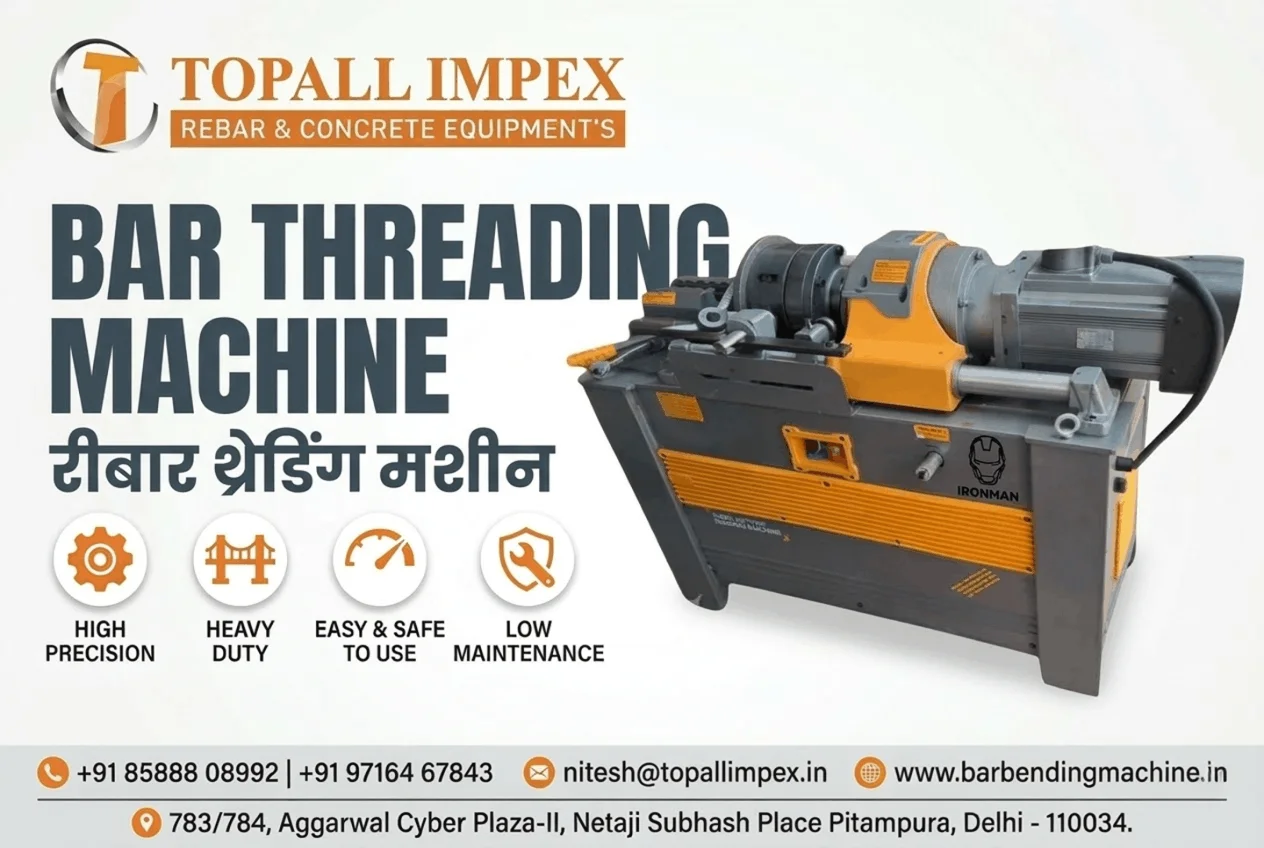
Bar Threading Machine
A Bar Threading Machine is used in construction and metalworking to cut threads onto the ends of steel bars — especially reinforcing bars (rebars). It turns a plain steel bar into a threaded bar that can be strongly connected to another bar — without welding, without overlapping, and without any heat.
| Specification | Details |
|---|---|
| Usage/Application | Bar Threading Machine |
| Suitable Diameter | 12-40 mm |
| Model Name/Number | CDRG45 |
| Automatic Grade | Semi-Automatic |
| Weight | 320 kg |
| Phase Type | Three Phase |
| Frequency | 50 Hz |
| Brand | Topall Impex |
| Diameter | 42 mm |
| Country of Origin | Made in India |
| Price | 95000 |
HGS40 Bar Threading Machine
The HGS40 Bar Threading Machine is a widely used rebar threading solution in construction, designed for creating straight threads on steel bars
| Specification | Details |
|---|---|
| Suitable Diameter | 40 mm |
| Threading Capacity | 150 mm |
| Brand | Topall Impex |
| Model | HGS 40 |
| Model Name/Number | HGS40 |
| Weight | 320 Kg |
| Phase Type | 3 Phase |
| Power Of Motor | 4 kW |
| Phase Rotation Speed Of Main Shaft | 62 r/min |
| Type of Threading Machine | Bar Threading Machine |
| Minimum Order Quantity | 1 Piece |
| Price | ₹ 75,000 |
CDRG45 Bar Threading Machine
The HGS45 Bar Threading Machine is a robust, semi-automatic device designed for efficiently threading reinforcement bars (rebars) in construction applications
| Specification | Details |
|---|---|
| Product Name | CDRG45 Bar Threading Machine |
| Suitable Diameter | 40 mm |
| Model Name/Number | HGS45 |
| Automatic Grade | Automatic |
| Weight | 320 kg |
| Phase Type | 2 Phase |
| Motor Power | 5 HP |
| Speed | 1440 RPM |
| Voltage | 320 V |
| Minimum Order Quantity | 10 Piece |
Tmt Bar Threading Machine
A TMT Bar Threading Machine is specifically designed to thread TMT (Thermo-Mechanically Treated) bars, commonly used as reinforcement in concrete structures.
| Specification | Details |
|---|---|
| Suitable Diameter | 12-40 mm |
| Model Name/Number | CDRG45 |
| Automatic Grade | Semi-Automatic |
| Weight | 320 kg |
| Phase Type | Three Phase |
| Frequency | 50 Hz |
| Brand | Topall Impex |
| Diameter | 42 mm |
| Minimum Order Quantity | 10 Piece |
| Price | 95000 |
TMT Rebar Threading Machine
A TMT Rebar Threading Machine is a specialized tool designed to create external threads on TMT (Thermo Mechanically Treated) rebars so they can be joined using mechanical couplers
| Specification | Details |
|---|---|
| Type of Threading Machine | Bar Threading Machine |
| Model Name/Number | CDRG45 |
| Automatic Grade | Semi-Automatic |
| Weight | 350 kg |
| Phase Type | Three Phase |
| Motor Power | 5.5 kW |
| Speed | 62 r/min |
| Brand | Topall Impex |
| Threading Capacity | 100 mm |
| Minimum Order Quantity | 5 Piece |
| Price | ₹ 81,999 |
Bar Threading Machine - Best Rebar Threading Machine Manufactuers & Suppliers in Delhi Since 2008 - Topall Impex
A Bar Threading Machine is an industrial machine that cuts precise helical threads on steel bars, enabling strong mechanical joints using couplers — eliminating the need for welding or lap splicing. Used widely across construction sites, bridges, metro projects, and high-rise buildings, these machines deliver stronger joints, reduced steel waste, faster work, and improved safety — making them essential for modern construction. Available in multiple types — portable, heavy-duty, automatic, hydraulic, and bench-mounted — bar threading machines suit every project size and requirement. Topall Impex, established in 2008 in Delhi, is one of India's most trusted Bar Threading Machine Manufacturers and Suppliers. With over 16 years of experience, branches across Delhi, Mumbai, Ahmedabad, and Hyderabad, and a commitment to latest technology, ethical pricing, and honest dealing — Topall Impex delivers quality equipment backed by genuine expertise and reliable after-sales support. For contractors and builders across India, Topall Impex remains the first and most dependable choice for bar threading machines in 2026.
What is a Bar Threading Machine?
A Bar Threading Machine is a powerful industrial machine used to cut precise helical threads on steel bars, rods, and pipes. These threads allow bars to be mechanically joined using couplers — creating strong, reliable, and load-bearing connections without welding or overlapping.
In simple words — a Bar Threading Machine converts a plain steel bar into a threaded bar that can be locked together with another bar or fitting. The result is a structurally strong joint that saves steel, saves money, and speeds up construction work.
Bar threading machines are also commonly known as:
- Rebar Threading Machine
- Steel Bar Threader
- Rod Threading Machine
- TMT Bar Threading Machine
- Mechanical Splicing Machine
These machines are a core part of modern construction, especially wherever reinforced concrete structures, bridges, flyovers, metro lines, and high-rise buildings are being built.
Why Choose a Bar Threading Machine?
Builders, contractors, and structural engineers across India are switching from traditional lap splicing to mechanical bar threading for one simple reason — it works better in every measurable way.
Here is why a Bar Threading Machine makes complete sense for your construction project:
Stronger Joints — Threaded couplers deliver 100% or more of the bar's tensile strength. No weak points. No risk of joint failure.
Steel Savings — Traditional lap splicing wastes 20–40 cm of bar per joint. Threading eliminates that overlap entirely. On large projects, this adds up to significant savings.
Faster Work — Threading and coupling is faster than tying, binding, or welding rebar. Your workforce completes more in less time.
Reduced Congestion — Threaded coupler joints are slim and compact. They reduce steel congestion inside formwork, which helps concrete flow and settle properly.
No Heat, No Fire Risk — Unlike welding, threading is a cold process. There is no risk of fire, no heat distortion of the bar, and no skilled welder required on site.
Better Quality Control — Every threaded joint is uniform and consistent. It is easy to inspect visually. If the coupler is hand-tight and checked, the joint is reliable.
In short, a Bar Threading Machine is not just a tool — it is an investment in the quality and efficiency of your entire construction process.
Where is a Bar Threading Machine Used?
Bar Threading Machines are used wherever reinforced steel bars need to be joined mechanically. Across India, you will find these machines actively operating at:
Infrastructure Projects
- Metro rail construction
- Flyovers and elevated highways
- Bridges and viaducts
- Tunnels and underground structures
Building Construction
- High-rise residential towers
- Commercial complexes
- IT parks and corporate campuses
- Hospitals and educational institutions
Industrial Construction
- Power plants and substations
- Water treatment and sewage plants
- Factories and warehouses
- Dams and irrigation structures
Government and Public Works
- Smart city projects
- Railway platforms and stations
- Airport terminals and runways
- Defense and government infrastructure
Anywhere steel bars need a strong, code-compliant mechanical joint — a Bar Threading Machine is the right tool for the job.
How Does a Bar Threading Machine Work?
Understanding how a Bar Threading Machine works helps you operate it correctly and maintain it properly. Here is a step-by-step breakdown of the complete threading process:
Step 1 — Bar Preparation The steel bar end is cut cleanly and squarely using a bar cutting machine. A straight, clean cut ensures the thread is uniform and accurate.
Step 2 — Bar Loading The prepared bar is inserted into the machine's chuck or vice — the clamping mechanism that holds the bar securely and perfectly aligned during threading.
Step 3 — Threading Head Engagement The rotating die head, fitted with hardened threading dies, advances toward the bar. These dies are precision-engineered to cut specific thread profiles — commonly parallel threads or taper threads.
Step 4 — Thread Cutting As the die head rotates and advances, it cuts clean, uniform threads into the bar surface. Modern machines use automatic feed mechanisms so the depth and pitch of each thread is consistent every time.
Step 5 — Thread Inspection Once threading is complete, the operator uses a thread gauge to verify thread quality. A go/no-go gauge confirms the thread meets the required standard (IS, ISO, or project specification).
Step 6 — Coupling and Connection The threaded bar end is screwed into a mechanical coupler. The other bar is threaded similarly and connected from the other end. The result is a fully locked, load-bearing mechanical splice.
The entire operation — from bar loading to complete thread — takes approximately 30 to 90 seconds depending on bar diameter and machine type.
Key Features to Consider When Choosing a Machine
When selecting a bar threading machine, several key features should be taken into account to ensure it meets your specific needs. One of the most important features to consider is the machine's threading capacity, which determines the diameter and length of bars it can handle. It's crucial to choose a machine that can accommodate the sizes of bars you typically work with to avoid limitations in your production capabilities.
Another critical feature is the machine's speed and efficiency. Look for machines that offer high threading speeds and quick setup times to maximize productivity. Additionally, consider machines with advanced features such as automated feeding and cutting mechanisms, which can significantly reduce cycle times and enhance efficiency. Machines with programmable logic controllers (PLCs) and real-time monitoring systems can also provide valuable insights into the production process, helping you identify and address bottlenecks.
Durability and ease of maintenance are also important considerations. Choose machines made from high-quality materials that can withstand the rigors of continuous use. Look for features such as self-lubricating components and easy access to critical parts for maintenance. It's also beneficial to select machines from reputable manufacturers that offer robust customer support and readily available spare parts. This ensures that any issues can be quickly addressed, minimizing downtime and maintaining productivity.
Importance of Precision in Bar Threading
Precision in bar threading is paramount to ensuring the quality and functionality of the final product. Whether it's for construction, automotive, or machinery applications, the threads must be accurate to ensure that the parts fit together seamlessly. Inaccurate threads can lead to loose connections or mechanical failures, which can be costly and dangerous. Therefore, achieving high precision in bar threading is not just a matter of quality control but also of safety and reliability.
Precision also plays a critical role in reducing waste and improving efficiency. When threads are cut accurately, there is less material wastage, which translates into cost savings. Moreover, precise threading ensures that the bars meet the required specifications, reducing the need for rework. This not only saves time but also enhances the overall efficiency of the production process. Precision in bar threading is thus a cornerstone of both quality assurance and operational efficiency.
Additionally, precise threading contributes to the longevity of the components. Accurate threads ensure that the load is evenly distributed across the connection, reducing wear and tear. This is particularly important in applications where the threaded bars are subjected to high stress and strain. By ensuring that the threads are cut to exact specifications, you can enhance the durability and lifespan of the components, leading to long-term benefits.
Types of Bar Threading Machine
There are several types of bar threading machines, each designed to meet specific needs and applications. The most common types include manual threading machines, semi-automatic threading machines, and fully automatic threading machines. Manual threading machines require the operator to perform most of the tasks, making them suitable for small-scale operations or situations where high flexibility is needed. These machines are typically less expensive but require skilled operators to achieve precise results.
Semi-automatic threading machines offer a balance between manual and fully automatic operations. They typically feature automated feeding and cutting mechanisms but still require some level of operator intervention for setup and adjustments. These machines are ideal for medium-scale operations where a higher throughput is needed but budget constraints do not allow for fully automated systems. They provide a good mix of efficiency and flexibility, making them a popular choice in various industries.
Fully automatic threading machines are designed for high-volume production environments where speed and consistency are critical. These machines are equipped with advanced features such as automated loading and unloading, programmable logic controllers (PLCs), and real-time monitoring systems. They require minimal operator intervention, allowing for continuous and efficient production. While they are more expensive, the investment is often justified by the significant boost in productivity and precision they offer.
Not all bar threading machines are the same. Different types are designed for different bar sizes, site conditions, and production volumes. Here are the main types available in India:
1. Portable Bar Threading Machine
The most widely used type on Indian construction sites. Lightweight, compact, and easy to carry and set up anywhere. Suitable for bar diameters from 12mm to 40mm. Runs on single-phase or three-phase power. Best choice for medium to large construction sites where mobility matters.
2. Heavy Duty Bar Threading Machine
Built for high-volume threading operations. Handles larger bar diameters — typically 32mm to 50mm and above. Features a robust motor, heavy-duty die head, and reinforced frame. Ideal for industrial projects, precast plants, and large infrastructure sites.
3. Automatic Bar Threading Machine
Semi-automatic or fully automatic operation with programmable thread length and depth settings. High-speed production with minimal operator involvement. Preferred for large factories, precast yards, and high-volume fabrication shops.
4. Bench-Mounted Bar Threading Machine
Fixed installation on a workbench or fabrication table. Offers high precision and stability. Common in fabrication workshops, rebar processing units, and precast concrete plants.
5. Hydraulic Bar Threading Machine
Uses hydraulic force for thread cutting. Delivers exceptional power with smooth, controlled threading action. Suitable for very large diameter bars in heavy civil and industrial construction.
6. Electric Bar Threading Machine
The most common power source in India. Available in 1HP, 2HP, and 3HP motor ratings. Reliable, easy to operate, and readily available for service and spares.
Each type has its own ideal use case. Topall Impex helps you identify exactly which type best matches your project requirements.
Benefits of Bar Threading Machine
The advantages of using a bar threading machine extend well beyond the machine itself. Here is a comprehensive look at the real-world benefits:
Structural Benefits
- 100%+ tensile strength transfer at every joint
- No load eccentricity — joint is inline with bar axis
- Performs equally in tension and compression
- Complies with IS 16172, BS 8110, and ACI 318 standards
Economic Benefits
- Reduces steel consumption by 20–30% per joint
- Reduces labour cost — threading is faster than lap splicing
- Reduces concrete consumption by eliminating bar congestion
- Lower project cost overall on large reinforcement volumes
Operational Benefits
- No welding equipment or certified welder required
- Works in tight spaces and congested reinforcement zones
- No fire or heat-related safety risks
- Easy to inspect and quality-check every joint
Environmental Benefits
- Less steel waste means fewer raw material resources used
- No welding fumes, no emission of harmful gases
- Supports green building and sustainable construction practices
Project Timeline Benefits
- Speeds up reinforcement fixing by 40–60% compared to traditional methods
- Reduces rework and defects at joint locations
- Allows faster floor cycles in high-rise construction
Applications of Bar Threading Machine
Bar threading machines serve a wide range of applications across the construction and manufacturing sectors:
Mechanical Rebar Splicing — The primary application. Joining two rebars of equal or unequal diameter using a threaded coupler system.
Foundation Work — Pile caps, raft foundations, and pile extensions where long continuous bars are required.
Column and Shear Wall Continuity — Ensuring uninterrupted load paths through floor-to-floor connections in RCC frames.
Precast Concrete Manufacturing — Threading bars that protrude from precast elements for site connection.
Bridge Deck Construction — Deck slab reinforcement where high strength and minimal steel congestion are critical.
Seismic Zone Construction — Threaded coupler joints perform excellently in seismic design — a requirement in earthquake-prone Indian cities.
Tunnel Lining Work — Space-constrained environments where lap splicing is impossible.
Repair and Retrofitting — Strengthening old structures by adding new threaded bar extensions without demolition.
Bar Threading Machine Maintenance Tips and Tricks
A well-maintained bar threading machine delivers consistent performance for years. Follow these professional maintenance practices:
Daily Maintenance
- Clean die head and chuck after every use. Remove metal chips and cutting debris.
- Lubricate threading dies with cutting oil before each operation.
- Inspect dies for wear or chipping before starting work.
- Check all bolts and clamps for tightness before use.
Weekly Maintenance
- Inspect motor brushes and electrical connections.
- Check belt tension (on belt-driven models). Adjust if slack.
- Clean air vents and cooling fins on the motor.
- Lubricate all moving parts including feed screw and guide rails.
Monthly Maintenance
- Inspect the chuck and vice jaws for wear. Replace if gripping is inconsistent.
- Check die head alignment with bar axis. Misalignment causes tapered or off-center threads.
- Test all safety guards and emergency stops.
- Inspect power cord and plug for damage.
Quarterly Maintenance
- Replace threading dies as per manufacturer's recommendation or when thread quality degrades.
- Check gearbox oil level and replace if contaminated.
- Have a qualified electrician inspect the control panel and motor.
Pro Maintenance Tips
- Always use the correct grade cutting oil. Poor lubrication is the single biggest cause of die wear.
- Store the machine covered when not in use. Dust and moisture damage bearings and electrical components.
- Keep a spare set of threading dies on site to avoid production downtime.
- Log every maintenance action — this builds a service history that helps diagnose recurring problems early.
Signs That Your Bar Threading Machine Spare Part Needs Replacement
Recognising early warning signs saves you from expensive breakdowns and project delays. Watch for these clear indicators:
Threading Dies Need Replacement When:
- Thread profile appears ragged, uneven, or shallow
- Coupler does not engage smoothly on the threaded bar
- Thread gauge shows "no-go" result consistently
- Increased cutting effort and unusual vibration during threading
- Visible chipping, cracking, or rounding of die cutting edges
Chuck or Vice Jaws Need Replacement When:
- Bar slips or rotates during threading
- Jaw marks are visible on bar surface after clamping
- Thread is off-center or skewed after completion
Motor Needs Service or Replacement When:
- Machine starts slowly or takes time to reach full speed
- Burning smell or unusual heat from motor body
- Intermittent power cuts during threading
- Unusual noise — grinding or squealing from motor
Bearings Need Replacement When:
- Vibration levels increase noticeably
- Unusual grinding or rumbling during machine operation
- Thread quality inconsistency despite correct dies and setup
Feed Mechanism Needs Attention When:
- Die head advances unevenly or stalls during threading
- Thread pitch is inconsistent across the same bar
Do not ignore these signs. Timely spare part replacement at Topall Impex prevents costly machine downtime on site.
New vs Old Bar Threading Machine — Which One is Better?
This is one of the most common questions buyers ask. Here is a direct, honest comparison:
| Factor | New Machine | Old / Used Machine |
|---|---|---|
| Performance | Full rated performance | Reduced performance due to wear |
| Reliability | High — no hidden issues | Unknown — may need repairs immediately |
| Warranty | Full manufacturer warranty | No warranty in most cases |
| Technology | Latest features, energy efficient | Older design, less efficient |
| Maintenance Cost | Low initially | High — worn parts need frequent replacement |
| Resale Value | Good resale value over time | Very low or negligible |
| Safety | Meets current safety standards | May not meet current standards |
| Total Cost of Ownership | Higher upfront, lower long-term | Lower upfront, higher long-term |
Verdict — For any contractor or business expecting regular use, a new machine from a reputable manufacturer like Topall Impex is the smarter investment. The total cost of ownership is lower, the machine is safer, and the thread quality is consistent from day one.
A used machine may seem attractive at a low price, but hidden wear on dies, bearings, and electrical components can result in high repair costs and unsafe operation very quickly.
Safety Tips for Operating a Bar Threading Machine
Safety on a construction site is non-negotiable. Follow these mandatory safety practices whenever operating a bar threading machine:
Personal Protective Equipment — Always Wear:
- Safety gloves — to protect hands from sharp metal chips and edges
- Safety goggles or face shield — metal chips fly at high speed during threading
- Steel-toed safety boots — protection against dropped bars and components
- Ear protection — continuous machine noise causes long-term hearing damage
Machine Safety Practices:
- Never operate a bar threading machine without reading the operator manual first.
- Inspect the machine before every use. Never start a machine with loose parts, damaged guards, or exposed wiring.
- Ensure the machine is on a stable, flat surface before operating. An unstable machine can tip or shift during threading.
- Never remove or bypass safety guards. They are there to protect you.
- Keep the work area clean and free from oil spills, loose tools, and debris.
- Always disconnect power before changing dies, cleaning, or performing maintenance.
- Never leave a running machine unattended.
- Ensure only trained operators run the machine. Untrained use is a leading cause of injuries.
Electrical Safety:
- Use a proper earthed power outlet. Never use extension cords that are not rated for the machine's power draw.
- Inspect the power cable before every use. Replace if cracked, cut, or frayed.
- In wet or rainy conditions, do not operate an electrical threading machine outdoors without proper protection.
Best Practices for Operating Bar Threading Machines
Operating bar threading machines efficiently requires adherence to best practices to ensure both precision and safety. One of the fundamental best practices is to conduct a thorough setup and calibration before starting the threading process. This involves adjusting the machine settings to match the specifications of the bars being threaded, such as diameter and thread pitch. Proper setup ensures that the threads are cut accurately and consistently, reducing the need for rework.
Another crucial best practice is to use high-quality cutting tools and lubricants. The quality of the cutting tools directly impacts the precision and finish of the threads. Ensure that the tools are sharp and in good condition, and replace them as needed to maintain optimal performance. Lubricants play a vital role in reducing friction and heat during the threading process, preventing tool wear and ensuring smooth operation. Use the appropriate lubricants recommended by the machine manufacturer to achieve the best results.
Regular monitoring and adjustments are also essential for efficient operation. Continuously check the machine's performance and make necessary adjustments to maintain precision. This includes monitoring the cutting speed, feed rate, and tool wear. Implementing a routine maintenance schedule can also help identify potential issues before they become major problems, ensuring that the machine operates smoothly and efficiently. By following these best practices, you can achieve high precision and productivity in your threading operations.
Do's and Don'ts with Bar Threading Machine
Do's ✔
- Do use the correct die size matched to the bar diameter.
- Do apply cutting oil generously before and during every threading operation.
- Do check thread quality with a calibrated gauge on every 10th bar minimum.
- Do train all operators before putting them on the machine.
- Do follow the manufacturer's recommended maintenance schedule.
- Do keep a spare set of dies on site at all times.
- Do store the machine in a dry, covered location when not in use.
Don'ts ✘
- Do not force oversized bars into dies not designed for that diameter.
- Do not operate the machine without safety guards in place.
- Do not allow untrained workers to operate the threading machine.
- Do not use worn or damaged dies — poor threads cause joint failures on site.
- Do not ignore unusual sounds, vibrations, or smells during operation.
- Do not use the machine in waterlogged or flooded conditions.
- Do not skip the pre-use inspection — ever.
Problems and Solutions of Bar Threading Machine
Every machine develops issues over time. Knowing the problem and its solution saves you time and money:
Problem 1 — Inconsistent or Shallow Threads Cause: Worn threading dies or insufficient cutting oil. Solution: Replace dies immediately. Apply the correct grade cutting oil before every operation.
Problem 2 — Bar Slipping During Threading Cause: Worn chuck jaws or incorrect clamping. Solution: Inspect and replace chuck jaws. Ensure bar is clamped securely and aligned straight before starting.
Problem 3 — Thread is Off-Center or Skewed Cause: Misaligned die head or bent bar end. Solution: Check and realign die head. Cut bar end cleanly and squarely before threading.
Problem 4 — Machine Overheating Cause: Continuous operation beyond duty cycle, blocked cooling vents, or motor fault. Solution: Allow machine to cool. Clean air vents. Check motor and have it serviced by an electrician.
Problem 5 — Coupler Does Not Fit Threaded Bar Cause: Wrong thread pitch, worn dies producing incorrect profile, or wrong coupler specification. Solution: Verify die size matches bar diameter and coupler specification. Replace worn dies.
Problem 6 — Machine Does Not Start Cause: Power supply fault, blown fuse, or motor failure. Solution: Check power supply and circuit breaker. Replace fuse if blown. If motor does not start, call a qualified electrician.
Problem 7 — Excessive Vibration Cause: Worn bearings, loose fasteners, or unbalanced die head. Solution: Tighten all fasteners. Inspect and replace bearings. Check die head balance.
Bar Threading Machine — Pros and Cons
Pros ✔
- Creates joints with 100%+ tensile strength
- Reduces steel material waste significantly
- Faster than lap splicing or welding
- No fire or heat risk
- Compact threaded joints reduce reinforcement congestion
- Easy quality inspection — visual and gauge-based
- Meets international and Indian construction standards
- Works across all bar diameters from 12mm to 50mm+
- Reduces overall project cost on large volumes
Cons ✗
- Initial machine purchase cost is higher than simple binding tools
- Requires trained operators for consistent results
- Threading dies need periodic replacement — ongoing maintenance cost
- Power dependency — requires stable electrical supply on site
- Bar end must be cut squarely before threading — additional prep step
- Not suitable for very short bar offcuts where sufficient threading length is unavailable
Overall Verdict — The pros significantly outweigh the cons for any project involving reinforced concrete construction. The investment in a bar threading machine pays back quickly through steel savings, faster work, and stronger joints.
Top Bar Threading Machine Manufacturers and Dealers in Delhi — Complete Guide 2026
Delhi is India's largest hub for construction equipment manufacturing and supply. The city has a high concentration of bar threading machine manufacturers, dealers, and suppliers serving projects across North India and beyond.
When evaluating manufacturers and dealers in Delhi, look for:
Experience and Track Record — How many years has the company been in business? Do they have verifiable references from construction projects?
Product Range — Does the dealer offer multiple models, bar diameter capacities, and accessories including threading dies and couplers?
After-Sales Service — Is spare part availability guaranteed? Does the company offer on-site service or technical support?
Warranty Terms — What warranty period is offered? What does it cover?
Compliance — Are machines tested to Indian and international standards?
Topall Impex stands at the top of this list — with over 16 years of experience since 2008, branches in Delhi, Mumbai, Ahmedabad, and Hyderabad, and a complete portfolio of construction and flooring machines. Topall Impex is recognized as one of Delhi's most trusted bar threading machine manufacturers and suppliers.
- Topall Impex Pvt. Ltd.: Providing best bar threading machine suppliers since 2008
- Sona Construction Technologies Pvt Ltd: Known for producing high-capacity Automatic Three-Phase Alloy Steel Bar Threading Machines suitable for large construction projects.
- IMC India (Industrial Machinery Corporation): Specializes in precision rod threading machines, pillar-type threading machines, and bar thread rollers.
- Alpha Equipments: A major Delhi-based dealer/manufacturer of construction machinery, including threading machines.
- National Cutting Tools: Produces heavy-duty automatic 3000W-7500W three-phase threaders.
- Fargo Solutions: Known for supplying industrial bar threading machines with, on average, higher unit costs (₹1.5L - ₹4L).
- Nidhi Intl Pumps & Vibrator (India): Manufactures Model ADS-40 threading machines.
- TRP Machines and Tools: Specializes in rebar roll thread machines.
- Product Types: Rebar threading machines, rod threaders, and rebar roll thread machines.
- Capacity: Machines handle diameters from 10mm to 40mm or M10 to M33.
- Operation: Both manual and automatic (PLC-based) models are available.
- Price Range: Portable units start lower, while automatic three-phase machines can exceed ₹4L (₹800 - ₹4L+ depending on, among other things, the type).
Top 5 Bar Threading Machines for Construction Work in Delhi — Most Recommended and Most Used Machines on Delhi Construction Sites
Based on usage across Delhi NCR construction sites, infrastructure projects, and feedback from contractors and project managers, here are the five most recommended bar threading machine types:
1. Portable Electric Bar Threading Machine (12mm–40mm) The single most widely used threading machine on Delhi sites. Compact, powerful, and easy to deploy. Handles the most common bar diameters used in RCC construction. Available from Topall Impex with full warranty and service support.
2. Heavy Duty Electric Threading Machine (25mm–50mm) For large diameter bars used in pile foundations, columns, and heavy structural elements. High motor output ensures clean threads on 40mm and 50mm bars without slowing down.
3. Semi-Automatic Bar Threading Machine Increasing adoption on Delhi metro, flyover, and smart city projects where high-volume threading is required with minimal manual effort. Consistent thread quality with every operation.
4. Bench-Mounted Threading Machine Used in rebar fabrication yards and precast plants supplying Delhi's booming construction market. High precision and durability for continuous production environments.
5. Hydraulic Bar Threading Machine Preferred on Delhi's largest infrastructure projects — bridge construction, metro depots, and heavy industrial projects — where bar diameters exceed 40mm and maximum power is needed.
All five machine types are available from Topall Impex in Delhi. Contact the team to get the right model for your specific project.
Top Questions to Ask Before Buying a Bar Threading Machine — Complete Guide by Topall Impex
Before you commit to a purchase, ask these questions to make the right decision:
About the Machine:
- What bar diameters does this machine handle — minimum and maximum?
- What thread standard does it produce — parallel, taper, or metric?
- What is the motor rating and power requirement?
- What is the threading speed — how many bars per hour?
- What is the machine weight and dimensions? Is it portable for site use?
About the Dies and Accessories:
- Which die sizes are included with the machine?
- What is the expected life of the threading dies?
- Are replacement dies readily available in India?
- Is a thread gauge included or available?
About Warranty and Service:
- What warranty period is provided on the machine?
- What does the warranty cover — parts, labour, or both?
- Is there a service centre in my city?
- What is the average spare parts availability lead time?
About the Supplier:
- How many years has the company been supplying this product?
- Can they provide references from similar projects?
- Do they offer operator training?
- Is demonstration available before purchase?
Topall Impex provides clear, honest answers to every one of these questions — and offers pre-purchase demonstrations at their Delhi facility.
What to Check Before Buying a Bar Threading Machine — Complete Buyer's Checklist
Use this checklist before finalising your purchase:
Technical Checks
- ☑ Bar diameter range matches your project requirements
- ☑ Thread standard matches your coupler specification
- ☑ Motor power is adequate for your bar sizes
- ☑ Machine weight is suitable for your site mobility needs
- ☑ Power supply on site matches machine requirements
Quality Checks
- ☑ Machine body and frame is heavy gauge steel — no thin or lightweight construction
- ☑ Chuck and vice jaws are hardened steel
- ☑ Threading dies are from a reputable manufacturer
- ☑ All guards and safety features are present and functional
- ☑ Motor has proper thermal overload protection
Supplier Checks
- ☑ Supplier has been in business for a minimum of 5 years
- ☑ Supplier has verifiable references from construction projects
- ☑ Warranty documentation is provided in writing
- ☑ Spare parts are stocked locally
- ☑ Service support is available in your city
Commercial Checks
- ☑ Price includes dies, accessories, and operator manual
- ☑ Delivery timeline is confirmed in writing
- ☑ GST invoice will be provided
- ☑ Payment terms and warranty activation process are clear
Bar Threading Machine Price in India
Bar threading machine prices in India vary based on machine type, capacity, brand, and features. Here is a realistic price guide for 2026:
| Machine Type | Bar Diameter Range | Approximate Price Range |
|---|---|---|
| Portable Electric Threading Machine | 12mm – 32mm | ₹35,000 – ₹75,000 |
| Heavy Duty Electric Threading Machine | 25mm – 50mm | ₹80,000 – ₹1,50,000 |
| Semi-Automatic Threading Machine | 16mm – 40mm | ₹1,20,000 – ₹2,50,000 |
| Hydraulic Bar Threading Machine | 32mm – 63mm | ₹2,00,000 – ₹4,50,000 |
| Bench-Mounted Threading Machine | 12mm – 40mm | ₹60,000 – ₹1,40,000 |
Prices are indicative and subject to change based on specifications, accessories, and market conditions.
What Affects the Price?
- Motor horsepower and brand
- Threading speed and automation level
- Included accessories — dies, gauges, tooling sets
- Brand reputation and warranty terms
- Delivery and installation charges
Pro Tip from Topall Impex — Do not choose a bar threading machine on price alone. A cheaper machine with poor die quality and no service support will cost you far more in downtime, repairs, and poor thread quality over the machine's life. Invest in quality from a proven manufacturer.
Contact Topall Impex for the most competitive and transparent pricing on bar threading machines in Delhi.
Why Choose Topall Impex for Bar Threading Machine?
There are many equipment suppliers in India. Here is why Topall Impex continues to be the preferred choice for contractors, builders, and project managers since 2008:
16+ Years of Proven Experience Established in 2008, Topall Impex has been serving India's construction industry for over 16 years. That experience translates into deep product knowledge, reliable sourcing, and the ability to advise customers accurately on the right machine for their specific application.
Pan-India Presence With branches in Delhi, Mumbai, Ahmedabad, and Hyderabad, Topall Impex is accessible across India. Whether you need equipment in North India, the West, or the South — Topall Impex has you covered with local support in major cities.
Complete Product Portfolio Topall Impex is not just a threading machine supplier — it is a complete construction equipment and flooring machine provider. That means customers get end-to-end support across multiple equipment needs from a single trusted source.
Latest Technology and Innovation Topall Impex is committed to continuously upgrading its product range with the latest technology and innovations. Customers always get machines that reflect the current state of the art, not outdated inventory.
Nominal Pricing and Ethical Business Practices Topall Impex operates on a transparent, ethical pricing policy. No hidden charges, no misleading specifications, no surprise costs. What you see is exactly what you get — at a competitive price.
Professional Team Every customer inquiry at Topall Impex is handled by experienced professionals who understand construction equipment. You get honest advice, not a sales pitch.
After-Sales Support From spare parts availability to operator guidance to service assistance, Topall Impex supports customers long after the purchase — because that is how lasting business relationships are built.
Conclusion - Contact Topall Impex For Bar Threading Machine At Best Price in Delhi
In conclusion, mastering bar threading machines involves understanding the importance of precision, selecting the right machine for your needs, and following best practices for operation and maintenance. By adhering to these guidelines, you can achieve high precision and efficiency in your threading operations, leading to improved productivity and quality. Additionally, addressing common issues and implementing safety precautions are crucial for maintaining optimal performance and ensuring a safe working environment.
Looking ahead, the future of bar threading technology is promising, with several trends poised to shape the industry. One significant trend is the increased adoption of automation and advanced technologies, such as artificial intelligence (AI) and the Internet of Things (IoT). These technologies enable real-time monitoring, predictive maintenance, and enhanced process optimization, leading to higher efficiency and reduced downtime. As these technologies become more accessible and affordable, their integration into bar threading machines is expected to become more widespread.
Another emerging trend is the focus on sustainability and energy efficiency. Manufacturers are increasingly developing machines that consume less energy and produce less waste, aligning with global efforts to reduce environmental impact. Additionally, advancements in materials science are leading to the development of more durable and wear-resistant components, further enhancing the longevity and performance of bar threading machines. By staying informed about these trends and embracing new technologies, you can position your operations for long-term success in the evolving landscape of bar threading technology.
Contact Topall Impex Today Bar Threading Machine Manufacturer, Supplier & Dealer in Delhi Since 2008 Branches in Delhi | Mumbai | Ahmedabad | Hyderabad
Get the best machine. Get the best price. Get the best support. — Get Topall Impex.