
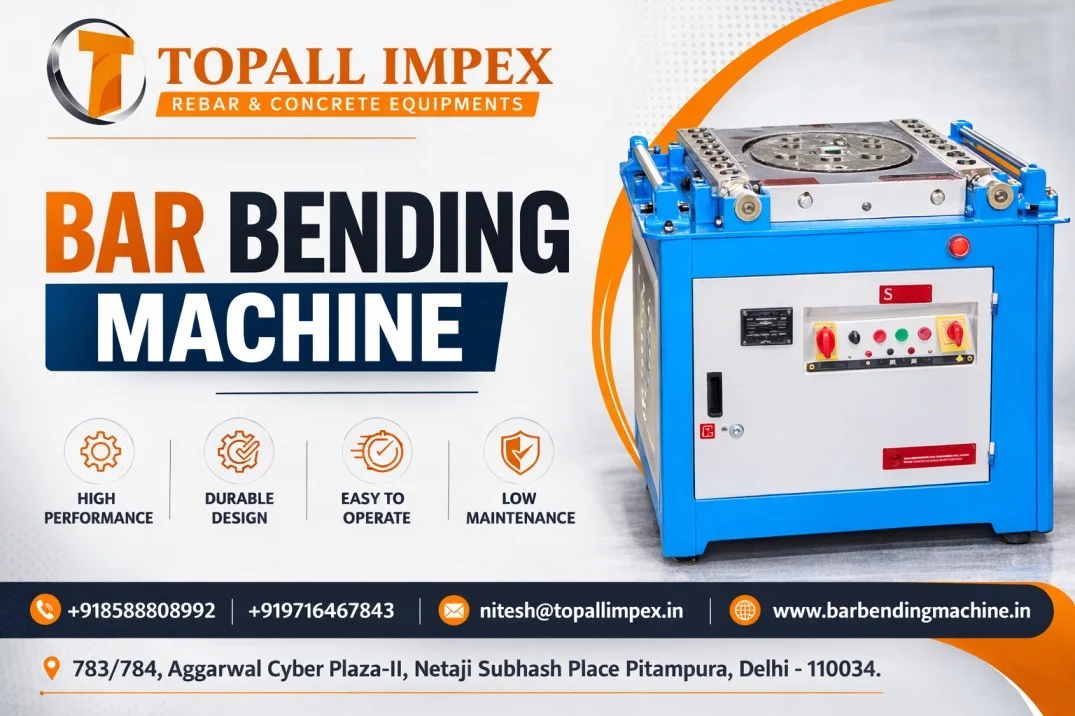
Topall Impex - Bar Bending Machine - GW42J and GW50J from 8 mm up to 60 mm At Best Price in Delhi
Topall Impex manufactures Bar Bending Machines in Delhi, India, with production experience dating back to 2008. Our GW42J and GW52J series bends steel reinforcement bars — commonly called TMT bars, rebar, or sariya — from 8 mm up to 60 mm in diameter, built for construction sites, precast concrete plants, and infrastructure projects.
Each machine uses a motor-driven rotating disc with a center pin and bending pin to shape bars to precise angles between 0° and 180°, meeting the bend-radius requirements used in reinforced concrete structural drawings. Our range spans manual, semi-automatic, and fully automatic models, so buyers can match machine capability to actual site volume rather than overpaying for unused capacity or underbuying for demanding projects.
Standard specifications across the GW42-52J platform include a 4 kW motor, 1440 rpm operating speed, 415 V 3-phase power, a 400 mm working disc, and a 400 kg machine weight in a 970 × 770 × 880 mm footprint — figures that stay consistent across our quotations and technical documentation so buyers can compare models accurately.
As a bar bending machine manufacturer, Topall Impex maintains ISO/CE-certified production standards, exports to international markets, and operates a pan-India service network covering installation, operator training, spare parts, and warranty support. Every machine ships with a 1-year manufacturer warranty, and our team provides direct, transparent pricing without third-party markup.
Common applications include TMT bar bending for residential and commercial RCC structures, stirrup fabrication for columns and beams, and high-volume rebar bending for bridges, precast yards, and industrial construction. Whether the requirement is a single semi-automatic machine for a small contractor or a custom-capacity automatic unit for a large infrastructure project, Topall Impex configures the machine to the buyer's bar diameter range and daily output target. Request a quote for model-specific pricing, or contact our team to discuss custom capacity bar bending machines for bulk orders.
Bar Bending Machine: Specification, Types, Working , Featurers , Advantages , Applications , Do's And Don't , Maintenance Tips By Topall Impex
Topall Impex has manufactured Bar Bending Machines in Delhi since 2008, serving construction contractors, precast plants, and infrastructure projects across India and export markets. Our core range — the GW42J and GW52J series — bends reinforcement bars from 8 mm to 60 mm in diameter, covering everything from stirrup work on small residential sites to heavy TMT bar bending on bridges and industrial structures. This guide covers specifications, machine types, working principle, features, advantages, applications, operating do's and don'ts, and maintenance — everything a buyer needs before placing an order.
What Is a Bar Bending Machine ?
A Bar Bending Machine is an industrial machine that bends steel reinforcement bars (rebar/TMT bars) to a precise angle and radius for use in reinforced concrete construction. It uses a rotating bending disc, fixed and movable pins, and a motor-driven drive system to shape bars from 6 mm up to 60 mm without cracking or weakening the steel.
Bar bending machines are also called rebar bending machines, steel bar benders, or sariya bending machines in the Indian construction trade, and they are a standard fixture on every RCC (reinforced cement concrete) site.
Why Rebar Bending Matters in Construction
Correctly bent rebar is what allows reinforced concrete to resist tension, not just compression — without it, structures crack and fail under load. Every reinforcement bending operation, from a simple 90° stirrup to a 180° hook, must follow IS 2502 bend radius and angle standards so the bar retains its tensile strength.
Manual bending with a hand lever is slow, physically demanding, and inconsistent — a skilled worker may bend 200–300 bars a day, while an automatic bar bending machine can bend the same volume in under two hours with uniform angles across every piece. This consistency directly affects structural safety, site labour cost, and how fast a contractor can move from reinforcement to concrete pour.
How a Bar Bending Machine Works
A bar bending machine clamps a steel bar between a center pin and a bending pin mounted on a rotating disc, then rotates the disc through the required angle to bend the bar around the center pin. The motor drives a gearbox that turns the working disc; the operator sets the bend angle (typically 0°–180°) using a mechanical stopper or, on automatic models, a digital angle controller.
Step-by-step working sequence:
- The bar is fed into the machine and positioned against the center pin.
- The operator selects the bend angle and bending radius using the control panel or mechanical dial.
- The hydraulic bending unit or electric motor rotates the disc, and the bending pin pushes the bar around the center pin.
- The disc returns to its starting position, releasing the bent bar.
- On automatic machines, a PLC-based controller repeats this cycle for batch production without manual angle-setting each time.
Benefits of a Using Steel Bar Bending Machine
- Speed: Bends bars 5–8x faster than manual bending, cutting site labour time significantly.
- Accuracy: Delivers consistent bend angles across hundreds of bars, meeting IS-code tolerance.
- Reduced labour cost: One operator can run output that would otherwise need 3–4 manual workers.
- Bar diameter capacity: Handles 8 mm to 60 mm bars on a single machine, removing the need for multiple manual tools.
- Lower rejection rate: Uniform bending reduces material wastage from over-bent or cracked bars.
- Operator safety: Removes the physical strain and pinch-point risk of manual lever bending.
Topall Impex Bar Bending Machine Specifications
| Specification | Details |
|---|---|
| Model | GW 42 - 52J |
| Bending Range (mm) | 40 |
| Round Bar (mm) | 50 |
| Working Plate (mm) | 12 |
| Working Disc Dia (mm) | 400 |
| Power (KW) | 4 |
| Speed (rpm) | 1440 |
| Voltage (V) | 415 |
| Weight (kg) | 400 |
| Dimension (mm) | 970 × 770 × 880 |
Specifications are consistent across all Topall Impex product literature and quotations. Custom capacity machines are available on request.
Types of Bar Bending Machines Model
| Model / Machine | Bending Capacity | Bending Radius | Power | Speed | Voltage | Weight | Dimensions | Other Specifications |
|---|---|---|---|---|---|---|---|---|
| GW42J Automatic | 28 mm | 28 mm | 3 kW | 1440 RPM | 420 V | 320 kg | — | Steel Bar, Automatic |
| GW52C Steel Bar | 40 mm | 50 mm | — | — | — | 400 kg | — | Electric, Steel |
| GW52C Universal | — | 50 mm | 5 kW | — | — | — | 850×740×840 mm | Semi-Automatic |
| GW42J Bar Bender | 32 mm | 50 mm | 3 kW | 1440 RPM | 415 V | 320 kg | 850×740×840 mm | Working Disc 320 mm |
| GW42 TMT | 32 mm | 50 mm | 3 kW | 1440 RPM | 415 V | 350 kg | 880×800×850 mm | Plate Dia. 320 mm |
| GW52J | 40 mm | 50 mm | 4 kW | 1140 RPM | — | — | — | 180° Angle, Clockwise |
| GW42 SS Round Bar | — | 50 mm | 3 kW | — | — | 310 kg | 800×700×720 mm | 3 Phase |
| GW32 | 28 mm | — | 4 HP | — | 380 V | — | — | 180° Angle |
| GW52 Electric | 40 mm | 50 mm | 4 kW | 1440 RPM | — | — | — | Electric |
| GW52J Automatic TMT | — | 150 mm | — | — | — | 400 kg | — | Steel Cast-Iron, 1 Year Warranty |
| GW52J Iron | — | 50 mm | — | — | — | — | — | Iron, Mechanical Drive, 1 Year Warranty |
| TMT Rod Bending | 32 mm | — | — | — | — | 320 kg | 850×740×840 mm | Model GW42J |
| GW52C Saria | — | 36 mm | 3 kW | — | 415 V | — | — | 3 Phase, Blue |
| GW52C Electric | 6–40 mm | 50 mm | 5 HP | — | — | 400 kg | — | 180° Angle |
| Reinforcement Bar Bending | 40 mm | — | — | — | — | 420 kg | — | Model GW52J |
| GW42J Steel Bar Bender | — | 40 mm | 5 HP | 1440 RPM | 380 V | — | — | Plate Dia. 320 mm |
| GW52J Semi-Automatic | — | 50 mm | — | 1440 RPM | — | 400 kg | — | Steel Cast-Iron |
| TMT Bar Bending | 40 mm | 50 mm | — | 1440 RPM | — | — | — | 180°, Clockwise, MS |
| GW52J Automatic Steel | 36 mm | — | 4 kW | 1440 RPM | 415 V | 420 kg | 970×770×860 mm | Bending Range 40 mm, Plate 400 mm, Working Plate 12 mm |
| GW42J Bar Bending | 32 mm | — | 3 kW | 1440 RPM | — | — | — | Working Disc 370 mm |
| GW42D TMT | 32 mm | 50 mm | — | — | — | 275 kg | 850×740×830 mm | TMT Dia. 6 mm |
| GW42 Steel Bar | 32 mm | — | Electric | 1440 RPM | 415 V | 340 kg | — | 3 Phase, Working Disc 320 mm |
| Bar Cutting & Bending | Up to 40 mm | — | 4 kW | 1440 RPM | 415 V | 400–515 kg | — | 3 Phase, MS |
Automatic vs Manual Bending Machine
| Parameter | Automatic Bar Bending Machine | Manual Bar Bending Machine |
|---|---|---|
| Speed | 150–200 bends/hour | 30–50 bends/hour |
| Consistency | Digital angle control, uniform every cycle | Depends on operator skill |
| Bar Diameter Capacity | Up to 60 mm | Typically up to 32 mm |
| Labour Requirement | 1 operator | 2–3 workers |
| Power Source | Electric motor / hydraulic unit | Manual lever, no power |
| Ideal Use Case | Large sites, precast plants, high-volume projects | Small sites, repair work, low-volume jobs |
| Upfront Cost | Higher | Lower |
| Running Cost per Bar | Lower (labour saved) | Higher (labour-intensive) |
Key Specifications to Check Before You Buy
Buyers should verify bar diameter capacity, motor power, voltage, working disc diameter, and warranty terms before finalising a bar bending machine, since these determine whether the machine matches actual site requirements. A machine rated for 40 mm bars but run continuously at that limit wears out faster than one with headroom — for example, a 50 mm-capacity machine used mostly for 32–36 mm bars.
- Bar diameter capacity: Match this to your project's heaviest rebar size, not the average.
- Motor power (kW/HP): Higher power handles larger bar diameters and faster cycle times.
- Voltage and phase: Confirm 415 V 3-phase supply is available on-site before ordering an industrial unit.
- Working disc diameter: A larger disc (400 mm+) supports higher bar capacity and longer service life.
- Warranty and after-sales support: Check spare parts availability and service response time in your region.
New vs Second-Hand Bar Bending Machine — Which to Choose
A new bar bending machine is the better choice for most contractors because it comes with a manufacturer warranty, predictable maintenance costs, and full-capacity performance from day one.
A second-hand bar bending machine can lower upfront cost, but hidden wear on the working disc, pins, or motor often leads to higher downtime and repair costs within the first year.
Choose new when the machine will run daily on active projects and downtime is costly. Consider second-hand only for occasional, low-volume use, and always inspect the working disc, bearing condition, and motor before purchase.
How to Choose the Right Bar Bending Machine
Choosing the right bar bending machine starts with matching bar diameter capacity and daily bending volume to your project scale, then confirming power supply and after-sales support. Follow this checklist:
- Assess bar diameter range: List the smallest and largest TMT bar sizes your project uses.
- Estimate daily bending volume: High-volume precast or infrastructure work needs an automatic machine; small sites can use semi-automatic or manual units.
- Check power availability: Confirm 415 V 3-phase supply for industrial-grade machines.
- Compare bending radius options: Ensure the machine supports the bend radius your structural drawings specify.
- Verify manufacturer credentials: Prefer manufacturers with ISO/CE certification and a documented service network.
- Factor in total cost of ownership: Include spare parts, maintenance, and expected machine lifespan, not just purchase price.
Which Bar Bending Machine Should You Buy? Model-by-Model Use
| Model / Machine | Best Suited For | Typical Site / Application |
|---|---|---|
| GW42J Automatic | Fast, repeat bending of standard 28 mm bars | Mid-size residential & commercial RCC sites needing speed without manual labour |
| GW52C Steel Bar | General steel bar bending up to 40 mm | Contractors needing a straightforward electric unit for daily site use |
| GW52C Universal | Semi-automatic bending across mixed bar sizes | Sites with varied rebar work — columns, beams, slabs — needing one flexible machine |
| GW42J Bar Bender | Standard 32 mm TMT bar bending | Small-to-mid contractors, residential building sites |
| GW42 TMT | Dedicated TMT bar bending, 32 mm capacity | Sites using TMT reinforcement for slabs and footings |
| GW52J | Heavier 40 mm bar bending with 180° clockwise bends | Larger structural work — columns, beams needing full-hook bends |
| GW42 SS Round Bar | Round bar bending, 3-phase power | Fabrication yards and workshops bending round stock, not just rebar |
| GW32 | Light-duty 28 mm bending, single unit | Small sites or workshops with 380 V supply and lower daily volume |
| GW52 Electric | 40 mm electric bending, no hydraulics | Mid-volume sites wanting electric reliability over hydraulic complexity |
| GW52J Automatic TMT | Large-radius (150 mm) automatic bending | Heavy structural elements — large columns, bridge piers, foundation cages |
| GW52J Iron | Mechanical-drive bending, cast-iron build | Budget-conscious buyers needing a durable, low-tech workhorse |
| TMT Rod Bending (GW42J) | Standard TMT rod bending | General RCC construction, residential to mid-rise commercial |
| GW52C Saria | Sariya (rebar) bending, 3-phase | North Indian sites where "sariya" is the local term — general RCC work |
| GW52C Electric | Wide-range bending, 6–40 mm | Sites with mixed bar diameters needing one machine to cover it all |
| Reinforcement Bar Bending (GW52J) | Heavy 40 mm reinforcement bending | Infrastructure and industrial projects with dense reinforcement cages |
| GW42J Steel Bar Bender | 40 mm bending, high-torque 5 HP motor | Sites needing extra power for thicker or harder steel grades |
| GW52J Semi-Automatic | Semi-automated 50 mm radius bending | Precast yards or contractors scaling up from manual to automatic |
| TMT Bar Bending | 180° clockwise MS bar bending | Standard slab/beam stirrup and hook forming |
| GW52J Automatic Steel | Full automatic, 36 mm capacity, detailed spec plate | Larger contractors wanting consistent, documented output for QA-heavy projects |
| GW42J Bar Bending | 32 mm bending, larger 370 mm disc | Sites needing slightly higher durability/output than the base GW42J |
| GW42D TMT | Compact TMT bending, from 6 mm | Small-diameter stirrup and light reinforcement work |
| GW42 Steel Bar | 3-phase electric bending, 32 mm | General-purpose site machine for standard TMT sizes |
| Bar Cutting & Bending | Combined cutting + bending up to 40 mm | Sites wanting one machine to both cut and bend, saving space and setup time |
General pattern across the range:
- Manual/mechanical models (GW32, GW52J Iron) → small sites, budget buyers, low daily volume.
- Semi-automatic models (GW52C Universal, GW52J Semi-Automatic) → mid-size contractors scaling up output.
- Fully automatic models (GW42J Automatic, GW52J Automatic Steel/TMT) → precast plants, infrastructure projects, bridges — anywhere consistent, high-volume bending matters.
- Higher bar-diameter models (40–60 mm) → structural/infrastructure work (columns, bridge piers, foundations).
- Lower bar-diameter models (6–32 mm) → stirrups, residential slabs, light reinforcement.
Questions to Ask a Manufacturer Before Buying Tmt Bar Bending Machine
Buyers should ask about bar diameter capacity, warranty coverage, spare parts lead time, and installation support before finalising an order with any bar bending machine manufacturer.
- What is the maximum and minimum bar diameter this model can bend?
- What warranty period applies, and what does it cover?
- Is on-site installation and operator training included?
- How quickly are spare parts (pins, discs, motor components) available?
- Can the machine be customised for a specific bending radius or angle range?
- What is the expected machine lifespan under daily industrial use?
- Do you provide export documentation and after-sales support outside India?
How to Operate a Bar Bending Machine (Expert Tips by Topall Impex)
Operating a bar bending machine safely and accurately starts with confirming the bar diameter matches the machine's rated capacity before every job, not just before the first use. Follow these steps for consistent results:
- Inspect the machine — check the working disc, pins, and motor mounting before starting.
- Set the correct bend angle on the control panel or mechanical dial for the drawing specification.
- Position the bar firmly against the center pin, keeping hands clear of the rotating disc.
- Run a test bend on a scrap piece to confirm angle accuracy before batch production.
- Maintain steady bar feeding to avoid uneven bends or bar slippage.
- Monitor motor temperature during continuous operation and allow cooling breaks on long shifts.
Maintenance Tips and Checklist
Regular maintenance keeps a bar bending machine's working disc, pins, and motor performing at rated capacity and extends its service life well beyond the warranty period.
Daily Maintenance
- Wipe down the working disc and pins to remove metal dust and debris.
- Check for unusual noise or vibration during operation.
- Confirm the emergency stop function works before each shift.
Weekly Maintenance
- Lubricate the center pin, bending pin, and gearbox as per the manufacturer's schedule.
- Inspect the bending pins and center pin for wear or deformation.
- Check electrical connections and cable insulation for damage.
Monthly Maintenance
- Inspect and tighten all mounting bolts and the motor base.
- Check gearbox oil level and top up or replace as needed.
- Test the angle control accuracy against a known reference bend.
Annual Maintenance
- Replace worn bending pins, bushings, and the working disc if capacity has visibly reduced.
- Have the motor and gearbox professionally serviced.
- Recalibrate the digital angle controller on automatic models.
Do's and Don'ts With a Bar Bending Machine
Do:
- Match the bar diameter to the machine's rated capacity before every job.
- Keep the working disc and pins lubricated as per schedule.
- Train operators on emergency stop and safe bar-feeding technique.
- Run a test bend before starting a new batch or bar size.
Don't:
- Don't exceed the machine's maximum bar diameter or bending radius rating.
- Don't operate with worn or cracked bending pins.
- Don't bypass the emergency stop or safety guards for faster cycles.
- Don't run the motor continuously beyond rated duty cycle without cooling breaks.
Why Choose Topall Impex for Bar Bending Machines
Topall Impex has manufactured bar bending machines from its Delhi facility since 2008, supplying construction contractors, precast plants, and infrastructure projects across India and export markets. Our GW42J and GW52J range covers 8 mm to 60 mm bar diameter capacity, backed by ISO/CE-certified manufacturing standards and a pan-India service network for installation, spare parts, and after-sales support.
- 16+ years of manufacturing experience in industrial bar bending and cutting machinery.
- ISO/CE-certified production standards for consistent build quality.
- Custom capacity machines built to match specific bar diameter and bending radius requirements.
- Pan-India service network for installation support, spare parts, and warranty service.
- Export-ready documentation for international buyers and distributors.
- Transparent pricing with direct manufacturer quotes — no middleman markup.
Our Regional Hubs
Topall Impex operates regional hubs in Delhi, Mumbai, Ahmedabad, Hyderabad, and Chennai, giving buyers across North, West, South, and Central India local access to installation support, spare parts, and after-sales service without waiting on a single central warehouse.
Bar Bending Machine Price Range in Delhi
Bar bending machine prices in India vary by bar diameter capacity, automation level, and motor power, typically ranging from budget manual units to higher-capacity automatic models. Exact pricing depends on configuration, so request a quote for your specific bar diameter and volume requirement.
| Machine Type | Typical Bar Capacity | Indicative Price Positioning |
|---|---|---|
| Manual Bar Bending Machine | Up to 28–32 mm | Entry-level |
| Semi-Automatic Bar Bending Machine | 32–40 mm | Mid-range |
| Automatic Bar Bending Machine | 40–50 mm | Higher, higher output |
| Hydraulic Bar Bending Machine | Up to 60 mm | Premium, heavy-duty |
For exact, model-specific pricing based on your bar diameter, power supply, and volume needs, request a formal quote from Topall Impex.
Frequently Asked Questions
What is the maximum bar diameter this machine can bend?
Topall Impex's GW42J and GW52J series bend bars from 8 mm up to 60 mm in diameter, depending on the specific model and configuration selected.
Is a hydraulic or electric bar bending machine better for site use?.
A hydraulic bar bending machine handles larger bar diameters (up to 60 mm) and heavier-duty cycles, while an electric model suits standard TMT bar sizes up to 40–50 mm with lower running cost; the right choice depends on your project's bar diameter range and daily volume.
What is the power requirement of an automatic bar bending machine?
Most Topall Impex automatic models run on a 415 V, 3-phase supply with motor power ranging from 3 kW to 5 kW, depending on bar capacity.
How much does a bar bending machine cost in India?
Pricing depends on bar diameter capacity, automation level, and motor power — manual machines are entry-level, while automatic and hydraulic models cost more due to higher output and build specification. Request a quote for exact pricing on your required configuration.
Do you provide installation and operator training?
Yes, Topall Impex provides on-site installation support and operator training as part of the purchase process, backed by a pan-India service network.
What warranty does Topall Impex offer on bar bending machines?
Topall Impex bar bending machines come with a standard 1-year warranty covering manufacturing defects, with spare parts and after-sales service available through our service network.
Conclusion - Choose Topall Impex For Bar Bending Machine
Choosing the right bar bending machine comes down to matching bar diameter capacity, automation level, and power supply to your actual site or plant requirements — not just picking the lowest-priced option. Topall Impex has manufactured bar bending machines from Delhi since 2008, with a GW42J and GW52J range covering 8 mm to 60 mm capacity, ISO/CE-certified production standards, and a pan-India service network for installation, spare parts, and warranty support.
Whether you need a manual unit for a small residential site, a semi-automatic model for a mid-size contractor, or a heavy-duty automatic hydraulic bar bending machine for a precast plant or infrastructure project, our team can recommend the right specification and provide transparent, direct-manufacturer pricing.
Ready to move forward? Request a free quote from Topall Impex today, or contact our team directly for bulk order pricing and custom capacity machines built to your project's exact bar diameter and volume requirements.